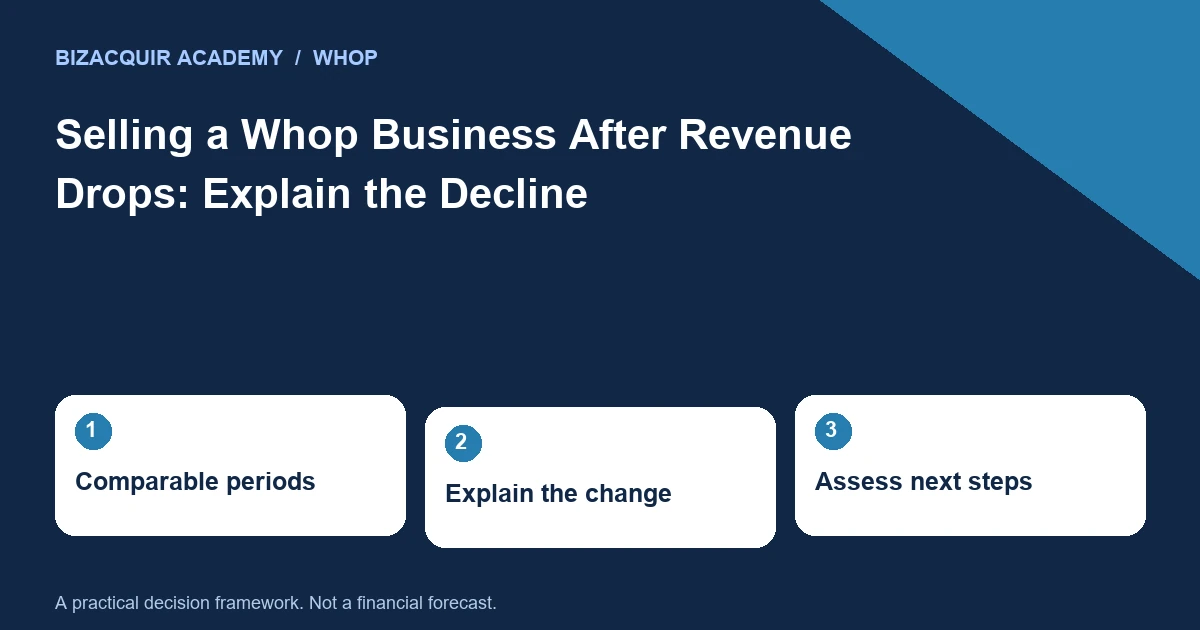
A revenue decline is easier to evaluate when the seller separates observations from explanations. “I stopped marketing” may be true, but a buyer needs to see when spending changed, what happened to renewals and whether the product continued to deliver value.
Compare like with like first
Choose completed monthly periods in the same currency and with the same metric definition. Separate gross collected payments from refunds and operating profit. Mark the current month as incomplete. If a provider only supplies part of the history, show that boundary rather than inserting zero months. Build a timeline beside the figures: pricing changes, content cadence, advertising pauses, staff departures, outages and seasonal events. Keep the financial series intact even when an event makes a month inconvenient.
Separate acquisition from retention
Fewer new members and more cancellations need different responses. Record new paying members, existing members who renewed, cancellations and payment failures where you have reliable data. Community headcount cannot stand in for paid-member retention.
| Pattern | Question to investigate | Useful supporting information |
|---|---|---|
| Fewer new customers | Did distribution or demand change? | Campaign dates, offer changes and acquisition channels |
| Weaker renewals | Did members still receive the promised value? | Cohort renewal history and delivery calendar |
| More refunds | Was there a mismatch or service issue? | Reasons, affected products and remediation |
| Lower cash collection | Were annual renewals uneven? | Billing schedule and comparable prior period |
Use a bridge, not a story that explains everything
Hypothetical example: gross monthly collections fall from USD 5,000 to USD 3,200. You can document USD 900 less from new customers and USD 500 less from renewals; another USD 400 is not yet explained. Show the unexplained portion. Do not attribute all USD 1,800 to marketing without evidence. Where figures are estimates, label them and explain the method. Never combine overlapping Stripe and Whop totals to make the bridge balance. One payment can appear in both sources.
Describe a recovery plan without selling a forecast
List actions already completed separately from ideas a buyer could try. “Restored the broken onboarding link on 10 September” is an observed action. “A buyer could test a revised onboarding sequence” is a proposal. Neither establishes future revenue. Give the buyer the inputs needed to judge the proposal: effort, recurring cost, skills and dependencies. Explain what failed previously. A credible recovery plan includes reasons the decline might persist, such as obsolete content or a niche that changed.
Present the sale fairly
Use the latest representative performance alongside the longer history. Do not price the business solely on its best month or quietly omit declining months. Your valuation should account for uncertainty and replacement work, not just apply a multiple to former peaks. In your listing, summarize the decline, link the dates to the connected financial section and describe your reason for selling in your own words. Prepare a short private question-and-answer document for buyers: what changed, what you tried, what remains unresolved and what access or evidence can support each answer. The goal is a buyer who understands the situation before negotiating.
Check the relevant provider guidance
These official references support the platform-specific steps. Your own contracts, account configuration and agreed sale terms still need to be checked.
Separate the causes before proposing a recovery
Build a before-and-after bridge using the same definitions. Split changes into new purchases, renewals, refunds and any supported price or product changes. Leave the unexplained remainder visible. A reduction in advertising and a decline in sales occurring together does not prove that restoring spend will restore the old result.
| Check | Useful answer |
|---|---|
| Known event | A dated campaign stop, outage or product change. |
| Observed effect | The actual payment or membership movement. |
| Interpretation | A proposed explanation, clearly distinguished from evidence. |
| Next check | The smallest record or observation that could clarify it. |
Your next practical step
Use the WHOP selling checklist to turn the gaps into a preparation plan. You can start a private listing draft or explore a free valuation; signup or login is required to view valuation results.
Continue with Selling a Whop Business With Revenue but No Profit and How to Value a Whop Business: Factors, Examples and Limits.