A valuation is an argument about a business and its risks, not a formula that discovers a guaranteed sale price. Start with reliable financials and a realistic picture of what will change after ownership changes. Then use scenarios to make your assumptions visible.
Name the financial basis before the multiple
“Three times” is incomplete. Three times monthly revenue, annual revenue and annual profit produce different numbers. MRR is another distinct measure: it is a recurring run-rate estimate, not automatically collected revenue or profit.
| Hypothetical calculation | Result |
|---|---|
| USD 4,000 monthly revenue × 3 | USD 12,000 |
| USD 48,000 annual revenue × 3 | USD 144,000 |
| USD 18,000 annual operating profit × 3 | USD 54,000 |
These are arithmetic examples, not comparable sales or recommended market multiples. None establishes what a buyer should pay. Use the same period and definition when comparing scenarios.
Normalise only what you can explain
Build a schedule from recorded results to any adjusted profit measure. Identify each adjustment, the evidence and whether a buyer would actually avoid that cost. If the owner performs substantial unpaid work, model the cost of replacing it rather than assuming it disappears.
Separate a genuine exceptional expense from a recurring inconvenience. Keep both reported and adjusted results available. A buyer may reasonably disagree with your adjustment; transparent records make that disagreement specific.
Assess the durability of the earnings
- Retention: Do paying cohorts renew, and how is churn defined?
- Concentration: Does one customer, affiliate or acquisition channel dominate?
- Owner dependence: Are members paying for a person who will leave?
- Transferability: Can the agreed assets and necessary permissions move?
- Costs: Are moderation, content and customer support fully accounted for?
- History: Is there enough consistent evidence to understand seasonality and promotions?
Different risks can justify different offers even when two businesses report the same revenue. A platform connection can help establish source and period, but it does not verify every cost or eliminate operating risk.
Build a downside case as well as a base case
Imagine revenue falls after the founder leaves while support costs remain fixed. Calculate whether the business still covers its costs and the buyer’s required work. Use explicit assumptions, not a smooth growth chart with no explanation.
For example, if hypothetical monthly revenue falls from USD 4,000 to USD 3,000 while monthly costs remain USD 2,500, the operating remainder falls from USD 1,500 to USD 500. That sensitivity may matter more than arguing about a small difference in a multiple.
Keep valuation, asking price and agreement separate
The seller’s Asking Price is a negotiation position. Buy Now is a separately configured action and amount. The completed sale price is the amount actually agreed and recorded. Do not use an asking-price archive as evidence of completed-sale values.
Before agreeing, define included assets, liabilities, transition work and fees. Use qualified financial, tax or legal advice for decisions requiring it. A valuation worksheet supports a decision; it does not replace due diligence or make the acquisition safe.
Worked valuation worksheet: define the earnings first
Every amount and multiplier in this example is hypothetical. It demonstrates a method, not a market benchmark, completed sale or recommended asking price. Assume a subscription business reports USD 4,000 average monthly revenue over twelve completed months and USD 2,000 monthly recorded operating expenses. Reported operating profit on that basis is USD 2,000.
| Monthly bridge | USD | Assumption to challenge |
|---|---|---|
| Reported revenue | 4,000 | Consistent period, refunds and revenue definition. |
| Recorded expenses | −2,000 | All ordinary business costs included. |
| Reported operating profit | 2,000 | Before the two adjustments below. |
| Replacement owner work | −600 | Unpaid owner tasks need six hours weekly; this is a budget assumption, not a wage benchmark. |
| One-off migration cost add-back | +100 | USD 1,200 was expensed in the year and is demonstrably non-recurring. |
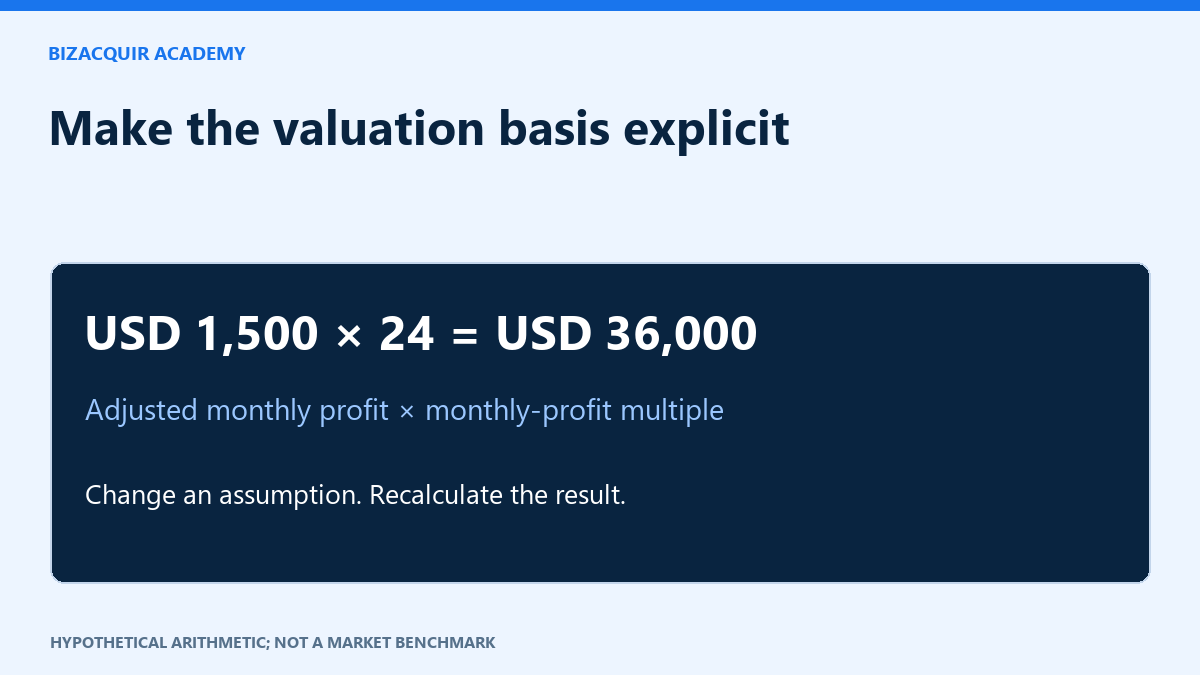
| Illustrative adjusted monthly profit | 1,500 | 2,000 − 600 + 100. |
The replacement-work assumption needs a deliverable scope and a realistic quotation. The add-back needs evidence that a buyer would not incur it again. If either assumption fails, change the calculation; do not hide it in a headline multiple.
Apply scenarios without pretending they are market prices
To demonstrate sensitivity, choose illustrative monthly-profit multiples of 20×, 24× and 28×. Applied to USD 1,500, they produce USD 30,000, USD 36,000 and USD 42,000. These multipliers are selected solely for this worksheet. They are not observed Whop market ranges.
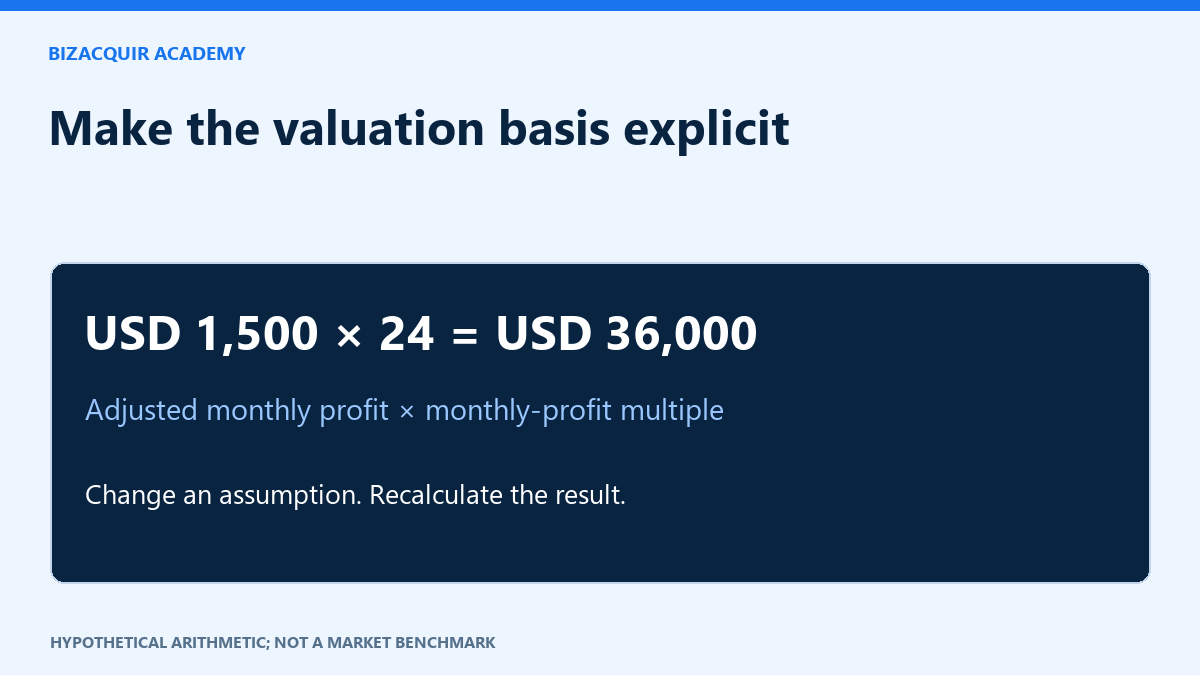
Original hypothetical valuation diagram: USD 1,500 adjusted monthly profit multiplied by 24 equals USD 36,000; the monthly basis is explicit.
At USD 36,000, a simple price-to-current-adjusted-profit calculation is 24 months. That is not a promised payback period: future earnings, reinvestment, taxes, financing, working capital and transaction costs can change the outcome. A revenue multiple must use revenue, not the USD 1,500 profit figure.
Stress the assumption that matters
If the founder leaves and monthly revenue falls to USD 3,000 while adjusted monthly costs remain USD 2,500, the remainder becomes USD 500. At an unchanged USD 36,000 price, the same simple ratio becomes 72 months. This exposes owner dependence more clearly than debating whether the initial multiple should be 23× or 24×.
Other scenarios can change a specific input: replacement labour, member retention, acquisition spending or an expiring supplier contract. Avoid changing every assumption in the optimistic direction. Keep a table of the reason for each change and the evidence needed to support it.
Finish with a decision sheet
- Chosen metric, reporting period and currency.
- Reported-to-adjusted earnings bridge, including owner replacement work.
- Assets, inventory or obligations included in the scenario.
- Multiple basis and why it is being considered.
- Downside assumptions and unresolved transfer dependencies.
- Asking Price, any Buy Now amount and transaction costs shown separately.
Use actual, relevant completed-sale evidence where available, checking source, date, disclosure limits and comparability. An anonymous row with missing profit or asset scope cannot establish a reliable multiple. Take material accounting, tax and contractual decisions to appropriately qualified advisers.
From an estimate to an asking price
Start with the valuation tool using a representative reporting period and the actual business model. Review the range against the work a buyer would inherit and the assets included. Then choose an asking price you can explain; the estimate does not set it for you.
An inactive business with past sales and zero current revenue needs a different assessment from a trading business with recurring earnings. Use the inactive option honestly. Do not enter a historical peak as current monthly revenue, and do not mark an active business inactive just because it is losing money.
Your next step
Ready to prepare your sale? Sell your Whop business or get a free valuation. Create an account or sign in to view your private estimate.
- MRR, Revenue, Profit and Refunds: Whop Metrics Explained
- How to Negotiate the Sale of a Subscription Business
Sources and useful references
- Whop: financial metric definitions
- Stripe: recurring metric assumptions
- BizAcquir: seller fee schedule
Translate the valuation into an asking-price discussion
Keep the estimate, asking price and an actual accepted offer separate. If a buyer must replace the founder’s work, first show the sustainable earnings adjustment and then discuss the multiple; do not apply the same dependence penalty twice. Show a conservative case and the specific evidence that would support a stronger case. A larger revenue figure alone does not establish a better multiple.
For inactive businesses, historical earnings explain what once operated; they are not current MRR. The valuation tool keeps inactive cases separate. You still choose a listing’s Asking Price explicitly—an estimate does not publish a business or overwrite connected data.