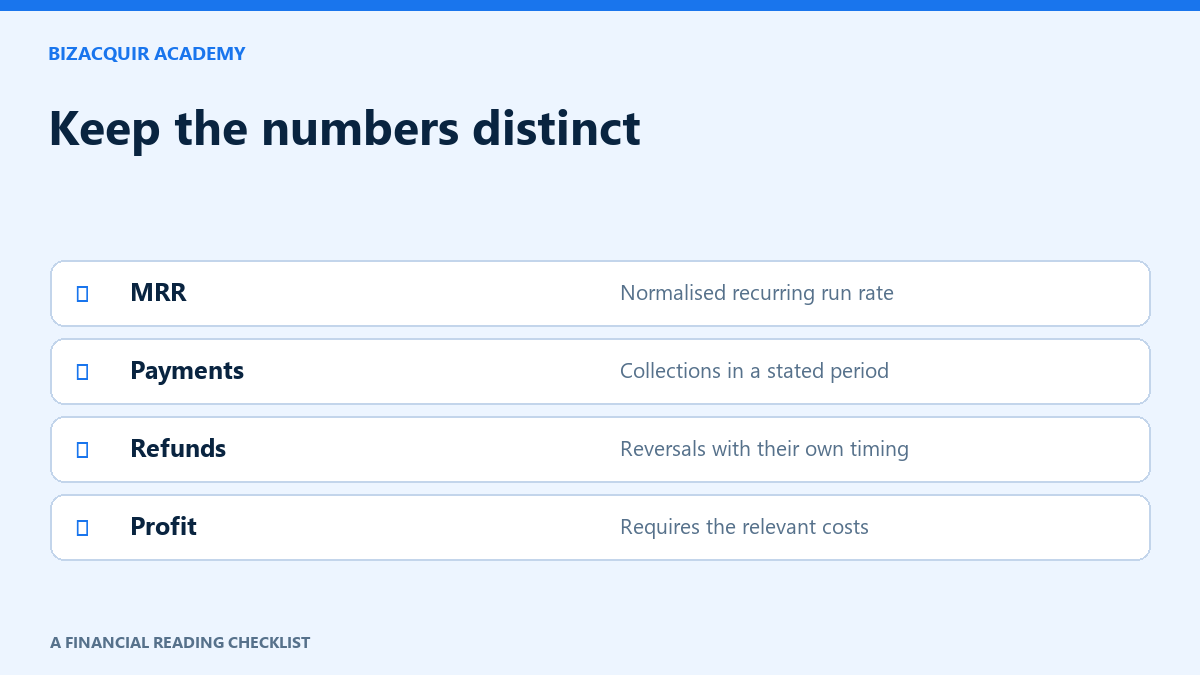
Four numbers can all be correct and still describe different things. MRR estimates a recurring run rate. Payments record money collected. Profit needs costs. Refunds reverse some customer payments. Before comparing a business, write down each metric’s period, currency and definition.
Understand what MRR does and does not say
In a simple hypothetical model, 50 active monthly subscriptions at USD 40 contribute USD 2,000 to MRR. Twelve active annual subscriptions at USD 240 contribute another USD 240 when each is normalised to USD 20 per month. The illustrative total is USD 2,240 MRR, before deciding how discounts and subscription states are treated.
That is not necessarily the cash received this month. Annual payments arrive at different times. One-time sales do not become recurring revenue because you divide them by twelve. Whop describes its MRR as an estimate covering active and past-due subscriptions, so check that state treatment before using the number as a collection forecast.
Reconcile revenue with money movement
| Measure | Question it answers |
|---|---|
| Gross payments or revenue | What did the selected source count before specified deductions? |
| Refunds | How much was returned, and on which event date? |
| Fees | Which processing or platform charges were incurred? |
| Payouts | What moved to a bank or destination after timing and balance adjustments? |
| Profit | What remains after a stated, complete cost basis? |
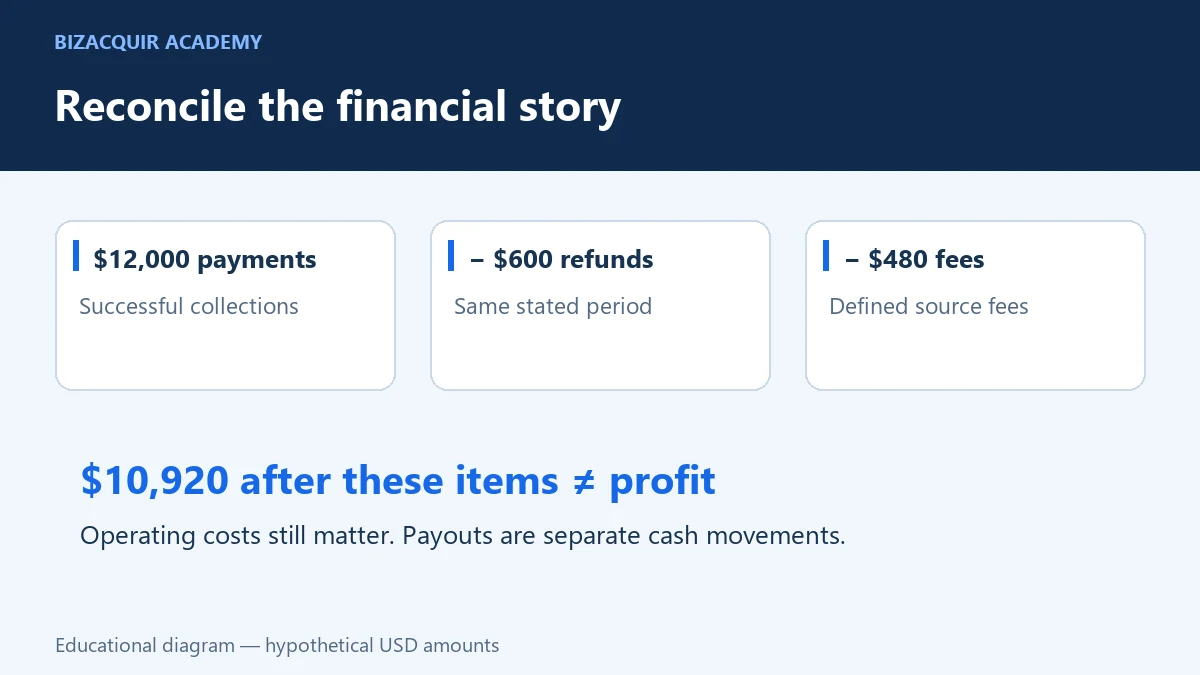
For an illustrative month with USD 5,000 payments and USD 300 refunds, the difference is USD 4,700 before other deductions. Calling that difference profit would ignore labour, software, acquisition costs and other expenses. Payout timing or retained balances can make the bank deposit different again.
Keep refunds and disputes separate
A refund is not automatically a dispute, and a dispute amount is not automatically a final loss. Record counts, amounts and outcomes separately. Define a refund rate’s denominator: refunded amount divided by original payment amount differs from refunded transaction count divided by transaction count.
When refunds happen after the original sale month, choose either an event-date view or a payment-cohort view and label it. Mixing a current-month refund numerator with an unrelated sales denominator can produce a misleading rate.
Compare periods and currencies fairly
Use completed months for trend comparisons and flag the current month as incomplete. Keep currencies separate unless you document a conversion source and date. “Lifetime” requires complete relevant history, not simply everything returned by a limited API request.
A community’s members and paying subscriptions also differ: one person can hold more than one membership, while free members do not necessarily contribute revenue. Preserve the source’s definitions and disclose the scope.
Read BizAcquir financial sections correctly
Seller-provided figures and imported snapshots are separate. A source label identifies where a snapshot came from; it does not establish profit, ownership or guaranteed future performance. Annual figures divided by twelve are labelled average monthly figures, not MRR. Compare the reporting period and freshness before comparing two listings.
Do not add Stripe, Whop and Shopify totals together: the same business activity can appear in more than one source. Ask how the figures reconcile, and treat unavailable metrics as missing information rather than zero.
Build a month-end reconciliation instead of one headline number
In this hypothetical USD example, a source records USD 6,000 successful customer payments during April and USD 400 refunds issued in April. Payments less those refunds are USD 5,600. Assume USD 350 actual payment/platform costs and USD 2,000 operating costs for the same business and basis: the simplified operating remainder is USD 3,250 before any omitted costs or tax. Each subtraction needs its own record; the example is not an accounting policy.
| Check | Why the answer changes the comparison |
|---|---|
| Do April refunds relate to March purchases? | An event-date refund view differs from refunds attributed to April's payment cohort. |
| Does the payment total include tax collected? | Collections may include amounts that are not the business's revenue. |
| Were annual plans collected this month? | Cash timing differs from the recurring run rate and service period. |
| Are disputes pending or finally lost? | A disputed amount is not automatically a realised loss. |
| Is the same payment in two sources? | Provider totals must not be added when they overlap. |
Write a definition beside every shared metric
A useful label is “Successful captured payments, USD, 1–30 April, source X, retrieved 2 May.” “Revenue verified” omits almost everything a reader needs. For a calculated refund rate, record whether it uses amount or transaction count and whether numerator and denominator use the same cohort.
Keep original source values alongside a reconciliation worksheet. If the worksheet cannot reconcile a difference, leave the difference visible and investigate it. Do not rename a payout as revenue or call a missing expense zero. The valuation guide shows how those distinctions affect an earnings-based scenario.
Your next step
- How to Value a Whop Business: Factors, Examples and Limits
- Build a Buyer Information Pack for Your Whop Business
Sources and useful references
Platform interfaces and requirements can change. Check the linked official guidance for your account before making changes.
Reconcile the dashboard before presenting a sale summary
A platform dashboard may estimate recurring revenue while a payment report records cash collected. Compare the dates, currency, included plans and refund treatment before deciding the figures conflict. An annual payment can create a large cash receipt without an equivalent jump in sustainable monthly income. Use the Whop report reconciliation worksheet to document differences rather than editing an imported figure.