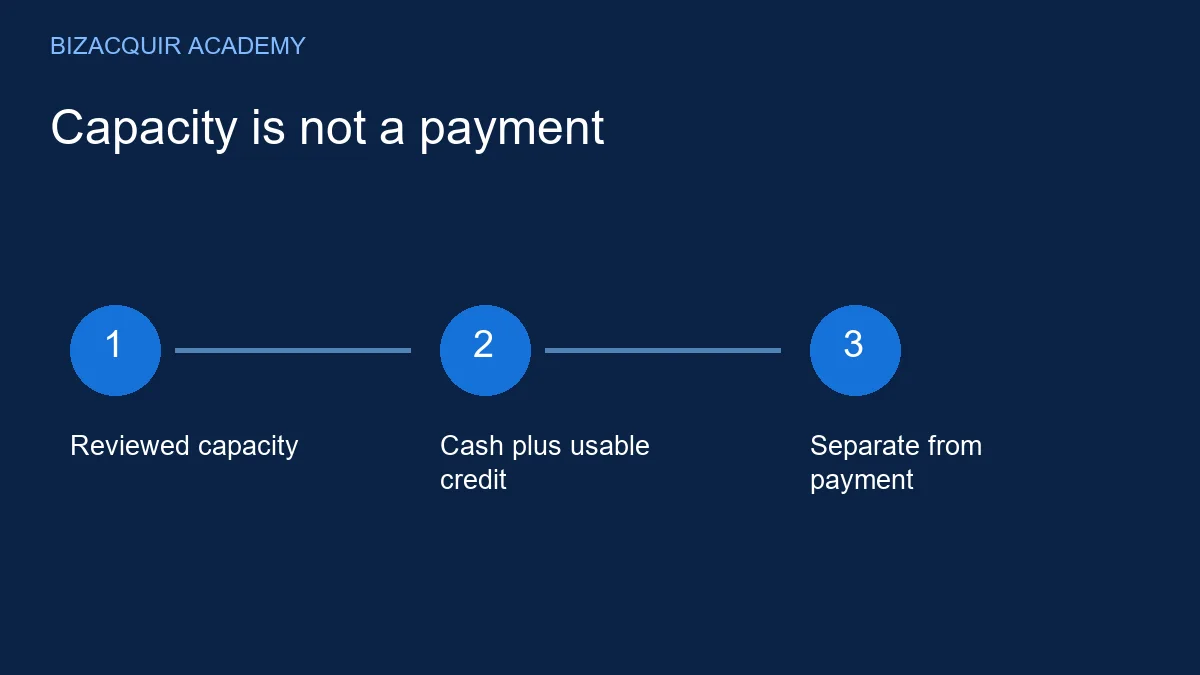
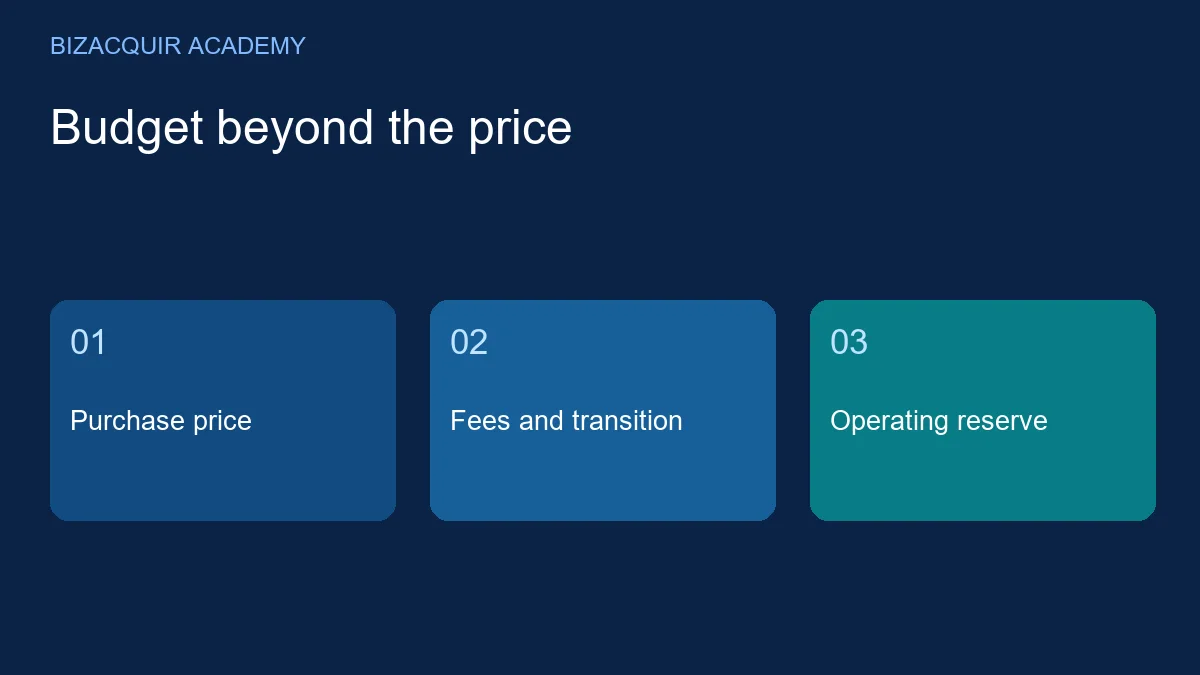
Your acquisition budget should leave room to run the business after buying it. Start with funds you can actually use, set aside reserves and transition costs, then work out a purchase-price ceiling. Do not treat a lender's headline limit, a future revenue forecast or the seller's asking price as your complete budget.
Separate the five amounts
| Amount | What it means |
|---|---|
| Available purchasing capacity | Funds available for the acquisition, subject to their actual conditions |
| Purchase price | The amount agreed for the included business assets or transaction scope |
| Transaction costs | Buyer fee and separately applicable professional or financing costs |
| Operating reserve | Money retained for ordinary expenses and timing gaps |
| Transition budget | Planned training, replacement services or restart work |
The US Small Business Administration's buying-an-existing-business guidance recommends considering the cost of both purchasing and managing the business. The size of your reserve depends on the operation; there is no universal number of months that fits every acquisition.
Work through a purchase ceiling
Illustrative USD example: you have USD 80,000 available, choose to retain USD 18,000 for operations and allocate USD 7,000 to transition and other costs. That leaves USD 55,000 for the purchase price plus BizAcquir's 2% buyer fee.
USD 55,000 divided by 1.02 is approximately USD 53,921.57. A simpler planning ceiling of USD 53,900 would produce a USD 1,078 buyer fee and USD 54,978 total, leaving USD 22 within that allocation. This arithmetic is not a valuation or a financing recommendation. Additional costs must be accounted for rather than assumed away.
BizAcquir's seller fee is separate: 7% on sale prices up to and including USD 50,000, and 5% above that threshold, applied to the whole sale price. It is not added to the buyer's 2% fee calculation. Check current pricing alongside the recorded transaction terms.
Use a reserve suited to the operating model
- Shopify: stock replenishment, supplier deposits, fulfillment, returns and advertising timing can consume cash before sales receipts arrive.
- Whop: member support, moderation, software and prepaid service obligations continue even if new sales slow down.
- SaaS: hosting, support, maintenance and usage-based services may need funding before renewals are collected.
- Inactive businesses: restart work is a separate cost; historical revenue is not current cash available to fund it.
Use the orders and obligations worksheet for ecommerce commitments. Keep amounts paid, amounts owed and estimates in distinct rows.
Account for financing conditions
If part of your plan depends on credit, establish the amount available, permitted use, timing, repayments and conditions with the provider. A conditional facility is different from money ready to transfer. Do not count borrowed cash already in an account again as unused credit.
An installment proposal can reduce the initial principal payment but creates later obligations. Model the full payment schedule and the buyer fee allocated to installments, not only the first payment. Do not assume future business earnings will cover every payment without a downside scenario.
Choose the request budget deliberately
Verified Funds and acquisition budget answer different questions. A reviewed total is purchasing capacity; the request budget is your intended purchase allocation. State the currency and explain material preferences in your request. A smaller budget than your verified total can be entirely sensible.
Before sending an offer, compare the proposed price with your valuation work, diligence findings and cash plan. If the numbers only work when every growth assumption succeeds, change the plan before committing.
Post your buying request or continue with Shopify buyer due diligence.