Buying a Shopify business means taking responsibility for its products, customers and operation—not just receiving a storefront login. A growing store can still have weak margins, ageing stock or a critical supplier relationship that will not continue. Use due diligence to establish what you are buying, how it earns money and what must work on day one.
This guide is for buyers of a complete business with trading history. Start with the public listing, then request appropriate evidence through the seller conversation and agreed private-document process. Do not ask the seller to publish customer lists or account credentials.
1. Define the business you can actually operate
Before comparing asking prices, write down your budget for the acquisition and the cash needed afterward: stock replenishment, marketing, fulfilment, app subscriptions and a reserve for returns. Decide how many hours you can work, which skills you have and which tasks need paid help.
An inventory brand, dropshipping store, print-on-demand business and subscription box have different operating risks. A cheap acquisition is not necessarily affordable if its next purchase order or daily support workload exceeds your capacity. Use the listing's operating model as a starting point, not a substitute for checking it.
2. Build a matched-period financial picture
Ask for monthly results over the available history, the currency and the definitions behind them. Compare completed months; keep the current partial month separate. Read connected figures beside their source and reporting period, then request the costs needed to understand earnings.
Shopify defines net sales as gross sales less discounts and sales reversals. Its sales report can include orders that have not been paid, so it is not interchangeable with settled cash. Check the current report definitions and reconcile differences with payment records rather than assuming one number is wrong.
- Compare sales, refunds, payment fees and bank receipts for matching dates; note timing differences and currencies.
- Reconcile product cost, freight, fulfilment, advertising, software and staff costs to the earnings statement. Check whether a cost has already been deducted.
- Separate one-off revenue, owner adjustments and discontinued products from ongoing performance.
- Review the latest months alongside a full seasonal cycle where available. Do not annualize a holiday peak as though every month repeats it.
Hypothetical earnings bridge
Suppose a store reports USD 240,000 of net sales over twelve completed months. Product cost is $96,000, fulfilment $24,000, advertising $36,000 and other operating costs $24,000. On those stated assumptions, operating profit is $60,000, or $5,000 a month. If the buyer needs another $12,000 a year of support labour to replace the founder's unpaid work, the buyer's planning figure becomes $48,000. This is an illustrative cost bridge, not an actual sale, an SDE calculation or a valuation multiple.
Ask the seller to explain any proposed add-back individually. A cost that the next owner must continue is not automatically removable just because the current owner chooses not to pay themselves.
3. Test where customers come from
Review traffic and sales together by channel and by month. A traffic spike without orders may be irrelevant; strong paid sales can hide deteriorating acquisition costs. Ask for a permitted walkthrough or appropriately scoped access to the underlying reports, not just a cropped graph.
| Check | Question to resolve |
|---|---|
| Organic search | Which landing pages and queries bring buyers? How much demand depends on the founder's name? |
| Paid acquisition | What spend, discounts and returns accompany reported sales? Can the buyer continue the creative and account arrangements? |
| Email and repeat buyers | Are repeat orders concentrated in a small cohort? What permission supports continued communication? |
| Affiliates and creators | Are relationships contracted, transferable and profitable after commissions? |
| Concentration | How dependent is the store on one product, country, supplier or customer? |
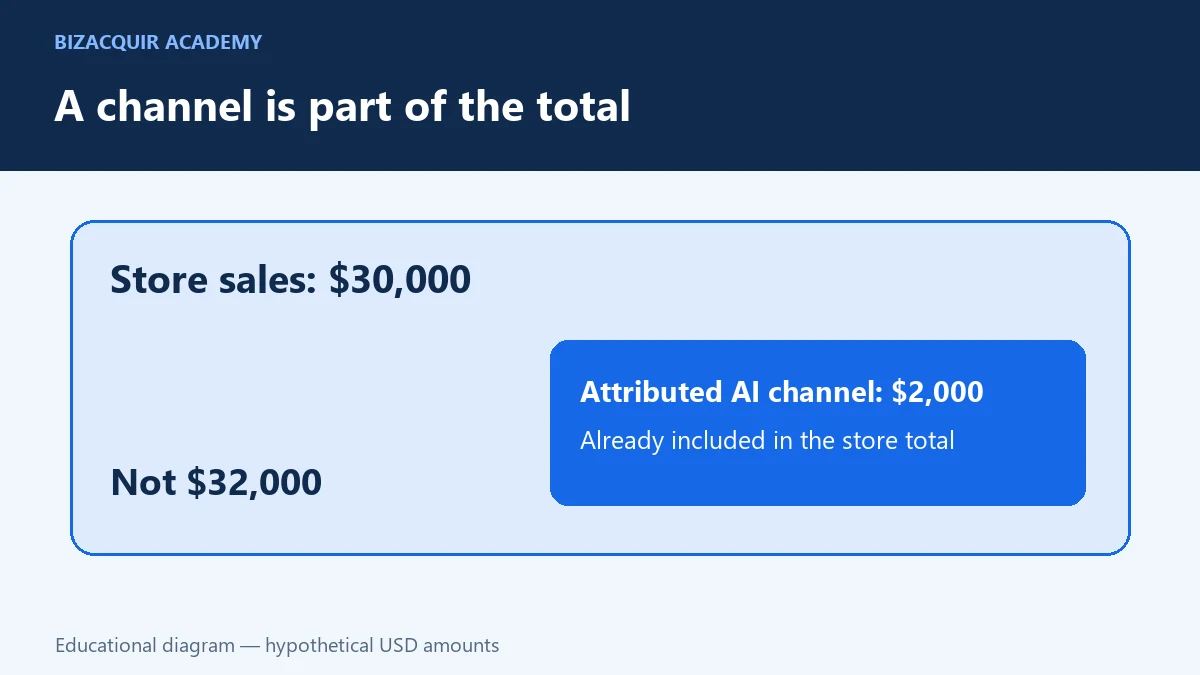
Ask what changed when performance improved or declined. A credible explanation links a dated change—price, product launch, campaign or supply interruption—to the records. Avoid treating attributed revenue from several analytics tools as additive sales.
4. Verify suppliers and inventory
Obtain a dated stock schedule and agree how counts will be checked. Record ownership, location, units reserved for orders, damaged stock, ageing batches and unit-cost basis. Consigned goods and stock held for another party are not automatically the seller's assets.
Hypothetical example: 100 units at a stated landed cost of USD 8 gives $800 of recorded cost before reviewing condition. If five are damaged and twenty are reserved for open orders, that information changes what is available and what obligations accompany it. It does not justify adding $800 to the price automatically. Agree the treatment, stock-count date and any closing adjustment explicitly.
Ask suppliers about minimum order quantities, lead times, payment terms, product rights and whether the relationship can continue for a new owner. Confirm fulfilment and return processes. Use written consent where the contract requires it; do not rely on the seller's expectation alone.
5. Map apps, accounts and ownership
List every service needed to accept an order, deliver it and support the customer. For each app or integration, record its purpose, cost, account owner, licence conditions and replacement difficulty. A small monthly app can be business-critical if it controls subscriptions or fulfilment.
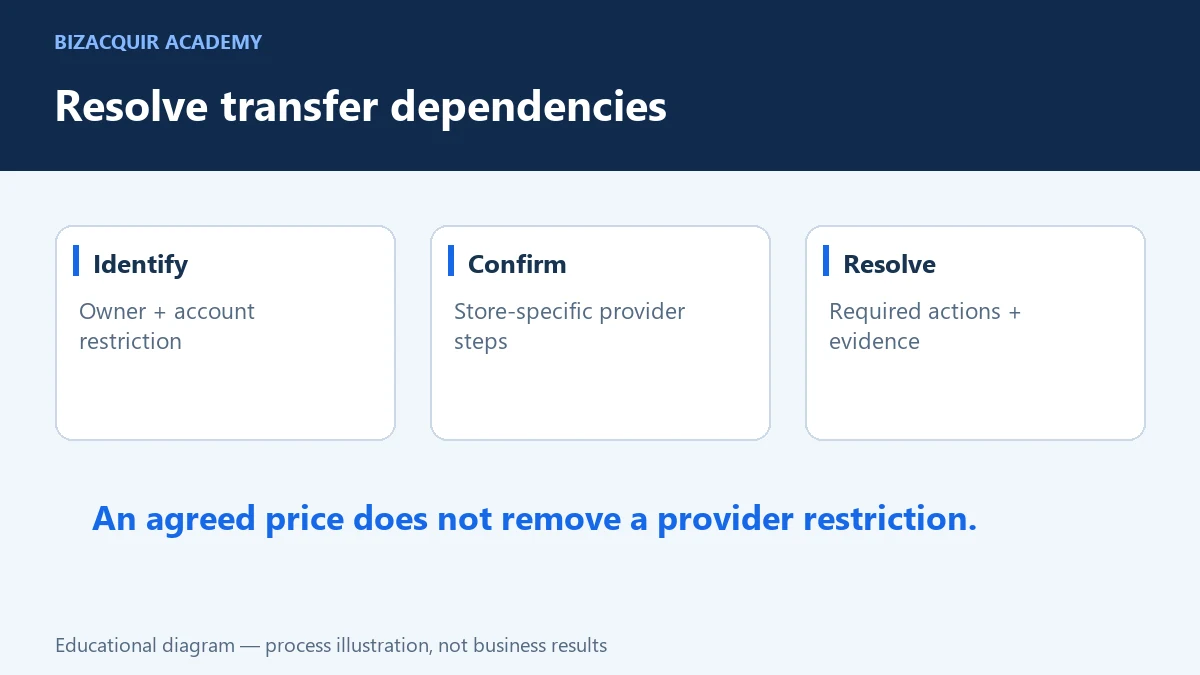
Shopify's ownership-transfer guidance distinguishes changing the owner to an existing user from transferring to a new owner. Only the store owner can perform the store ownership change. Check the current plan and any restrictions before agreeing a date. Domain registration, app contracts, brand rights and external services each need their own plan.
Read the Capital, Credit and transfer-restrictions guide where relevant. Do not assume a payment account, financing agreement or customer-data permission transfers with the store.
6. Turn findings into clear conditions
Keep an exception log with the question, evidence, impact, responsible person and due date. Distinguish a missing document from a confirmed problem. For example, an unsigned supplier confirmation is unresolved; a supplier's refusal to continue is a known operating constraint.
- Proceed: the evidence supports the business and the handover is achievable.
- Clarify or renegotiate: a specific cost, asset or obligation needs different terms.
- Pause: essential ownership, revenue or transfer information cannot yet be established.
Record the agreed assets, exclusions, inventory treatment, obligations, handover tests and inspection period in the same agreement version both parties review. A worksheet does not replace those terms.
7. Move from research to an informed offer
Browse businesses, sign in to review permitted financial details and contact the seller through BizAcquir. An enquiry is a way to clarify the opportunity; it does not commit you to buy. Formal offers and deal steps follow the requirements shown in your account.
The buyer fee is 2% on top of the agreed sale price. A hypothetical USD 10,000 sale therefore means a $200 buyer fee and $10,200 payable by the buyer, before any separately agreed items. Review the current pricing and transaction process. Payment is coordinated through the private deal workspace; follow its instructions and keep deal communication on BizAcquir.
Your practical buyer pack
Open the printable buyer due-diligence worksheet · Download editable CSV. Keep your completed copy private.
Open the printable inventory worksheet · Download editable CSV. Keep your completed copy private.
Open the printable transfer plan · Download editable CSV. Keep your completed copy private.
Next: browse Shopify businesses, or use the handover checklist to turn agreed conditions into a transfer plan.