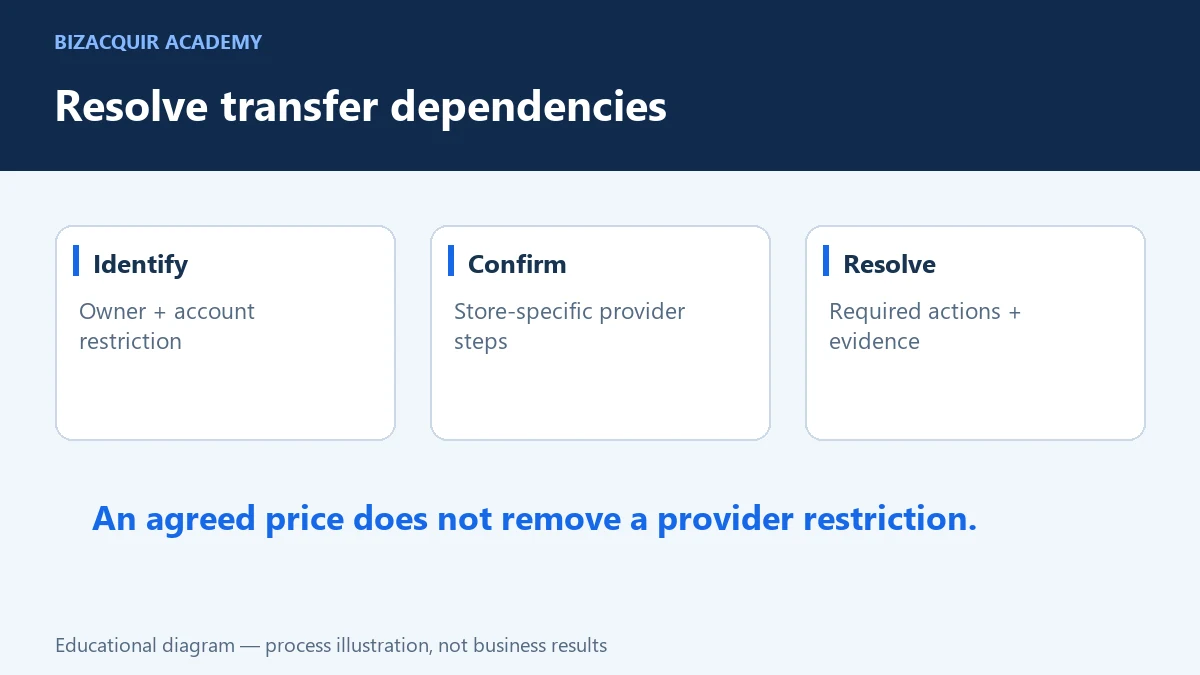
A buyer and seller can agree a price while a provider restriction still prevents the planned handover. Identify that restriction before promising a completion date. The solution is an account-specific, supported transfer plan—not sharing the seller’s login or assuming the sale contract transfers every financial obligation.
Check ownership-transfer eligibility early
Shopify’s current ownership-transfer guidance identifies restrictions involving Shopify Capital and Shopify Credit. It also describes steps for an active Shopify Balance account, including emptying it and contacting support. Read the current requirements for the actual store and obtain account-specific guidance where necessary.
This is not a recommendation to move funds or repay an obligation in a particular way. Do not alter balances for a sale demonstration. The seller needs to establish what Shopify requires and whether the proposed transaction can meet it.
| Question | Record privately | Do not assume |
|---|---|---|
| Who can initiate the transfer? | Current store owner and supported transfer path | A collaborator invitation equals ownership |
| Is there financing or credit? | Product, current status and provider response | The buyer can simply take over the obligation |
| Is Balance active? | Required account-specific closure or support steps | Changing an email resolves it |
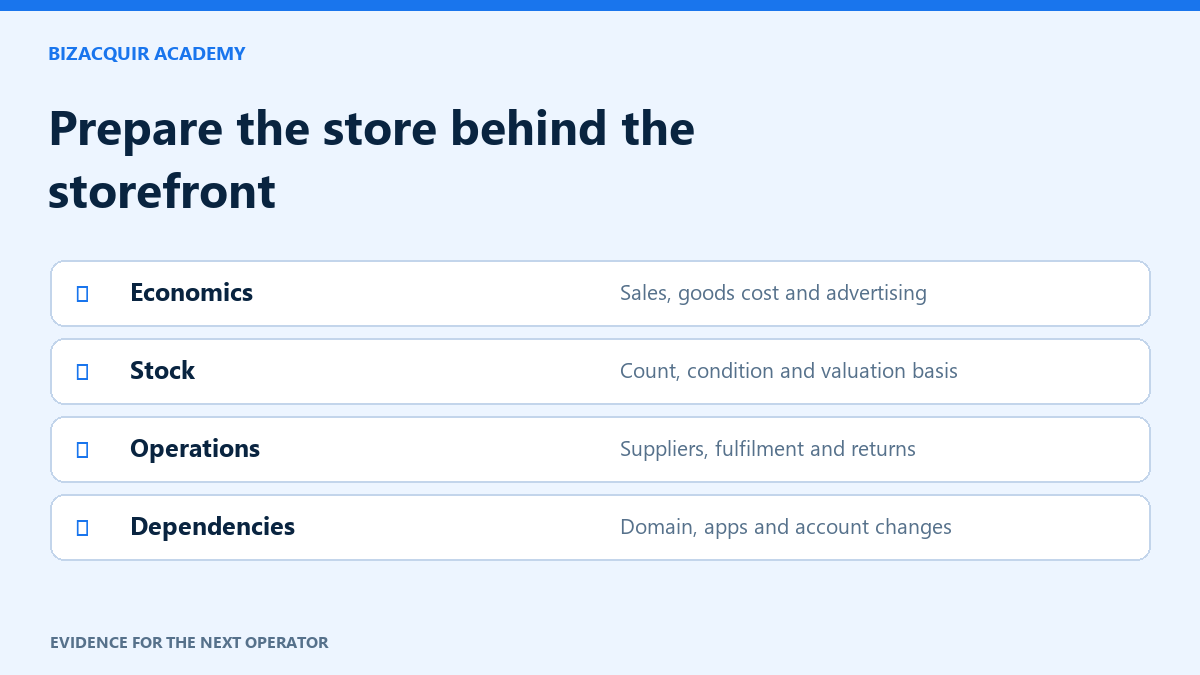
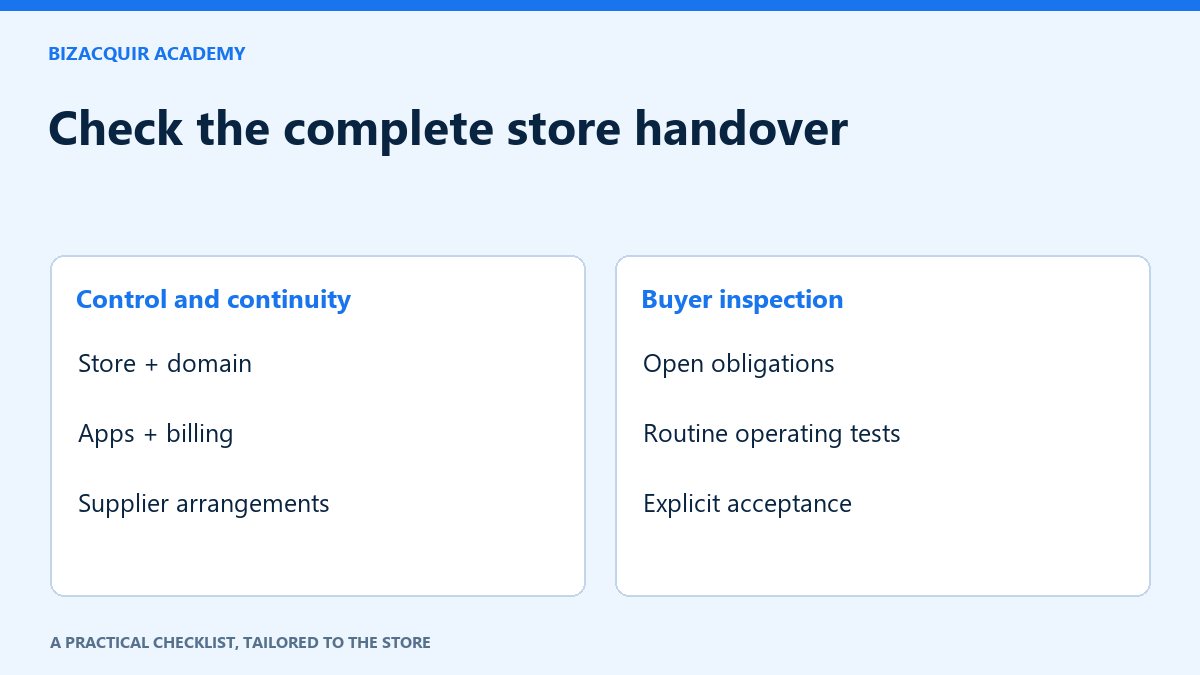
| Are external assets included? | Domain, apps, supplier and service arrangements | A store transfer transfers all contracts |
| What remains unresolved? | Responsible person and next evidence needed | An agreed price means the store is transferable |
Build a resolution log before finalizing the handover
Use one row per unresolved condition: the issue, the provider’s instruction, the person responsible and the confirmation needed. Keep sensitive account documents private. A prospective buyer usually needs to know the effect on timing and transferability, not the seller’s bank details.
If the answer is uncertain, describe it as unresolved. Do not state “fully transferable” on the basis of a generic help page. A support response about one store or product should not be generalized to every seller.
A sensible order of work
- Confirm that the seller has the authority and access needed to initiate the supported ownership transfer.
- Identify financing, credit, balance and other account-specific restrictions using current records.
- Ask Shopify a precise question about the proposed store ownership change and request the steps applicable to that account.
- Record which required actions can be completed before agreement and which affect completion timing.
- Include unresolved transfer conditions in the deal discussion using the existing agreement workflow. Do not invent a unilateral right to override the provider.
- Recheck the relevant state before the actual transfer; an older screenshot may no longer be accurate.
Hypothetical example: price agreement is not transfer readiness
Suppose a seller and buyer discuss a USD $40,000 store sale. The store has an unresolved provider restriction. The $40,000 offer does not demonstrate that ownership can move on the chosen day, nor does it establish how an existing obligation will be funded. Those are separate questions.
A useful next step is a written list of the provider-required actions and a realistic dependency in the handover plan. It is not a new promise that BizAcquir, the buyer or the sale proceeds will automatically settle the obligation. Any actual funding or settlement arrangement needs the applicable parties’ agreement and the existing approval process.
Keep ongoing customer obligations visible
Open orders, returns, gift cards, subscriptions and disputed payments can remain relevant around a sale. They should be allocated explicitly in the recorded terms. Provider transfer eligibility does not replace the commercial agreement about who will fulfill those obligations.
A closed or inactive store also needs an access and restart plan. Genuine past sales may qualify a business for BizAcquir, but past revenue does not remove Shopify restrictions or prove that suppliers and apps will continue unchanged.
What not to do
- Do not offer a password handover as a substitute for the supported transfer.
- Do not publish loan, bank or customer records in the listing.
- Do not claim provider approval based on a draft sale agreement.
- Do not rewrite past transactions to make an unresolved balance disappear.
- Do not advertise a cleared restriction until the relevant confirmation exists.
Prepare the business while resolving the dependency
You can organize the asset schedule, financial history and operating instructions while waiting for a provider response. Draft saving remains available on BizAcquir. First submission still needs a genuine successful financial connection and import; a historical sale showcase entry is not a substitute.
Read the Shopify handover checklist and the inactive-store selling guide. Then start preparing your Shopify sale with the unresolved condition clearly identified.
Sources and further reading
Sources checked on October 23, 2026. Provider features and account eligibility can change; confirm the current options in your own account.