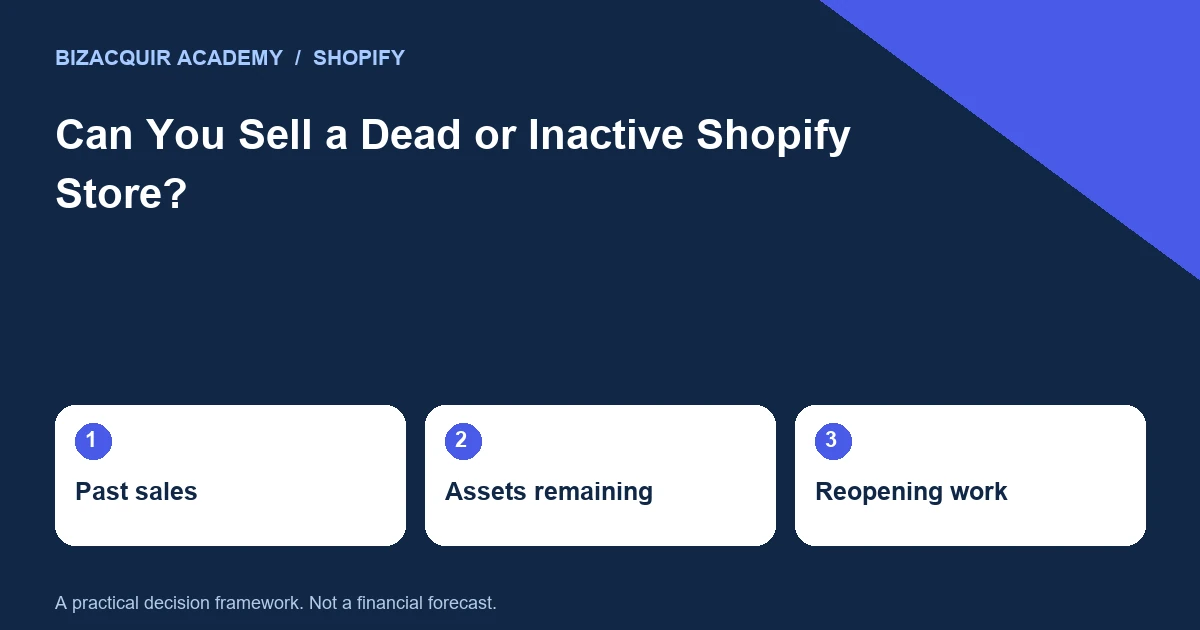
“Dead store” can mean a paused shop, a closed storefront, an exhausted advertising strategy or a business the owner stopped maintaining. Those descriptions do not tell a buyer what remains. A useful sale proposition identifies the past revenue, current access and assets that can support a genuine business transfer.
Establish what still exists
Check the store’s account status, domain, product catalogue, theme, content, inventory and supplier relationships. Record when orders stopped and why. Distinguish a storefront that is hidden from one that cannot currently process orders, and explain what is required to restore access. Shopify’s deactivation guidance describes retained store data and reactivation conditions. Do not assume every old store remains recoverable: data deletion, elapsed time and account circumstances matter. Confirm your own store’s position before promising it to a buyer.
Separate saleable assets from former performance
| Asset | What a buyer needs to assess |
|---|---|
| Brand and domain | Ownership, continued relevance and transfer route |
| Product content | Rights, quality and whether it is still accurate |
| Inventory | Actual quantity, condition and ownership |
| Suppliers | Current terms and willingness to work with a buyer |
| Operating knowledge | Documented processes and restart costs |
Past advertising results can help explain the business, but they do not guarantee that the same campaigns will work now. A payment account or a historical order count alone is not the business being sold.
Reconstruct the trading history
Use completed periods and separate gross sales, refunds, payment collections and operating costs. Explain whether figures include tax, shipping or other items. Keep currencies separate and do not count overlapping provider records twice. Hypothetical example: a store generated USD 40,000 in a past year and has had no sales for six months. Its listing can show that dated history alongside current zero revenue. It should not describe the store as generating USD 3,333 every month or use the old peak to imply current profit.
Find obligations that survived closure
Check open orders, returns, gift cards, subscriptions, chargebacks and supplier balances. Shopify’s billing guidance highlights that deactivation does not necessarily remove these responsibilities. Agree who handles them and avoid offering inventory already owed to customers as uncommitted stock. Estimate the practical restart work: plan access, app setup, updated products, fulfillment, support and acquisition. Label cost estimates and identify unknowns rather than treating all reactivation work as trivial.
Prepare the listing and supported transfer
BizAcquir accepts active or inactive full businesses with genuine past revenue. Save your draft, mark the operation Inactive and describe the relevant period. First submission still requires a successful authorized financial import. Whop, Stripe or Shopify may be relevant depending on the business; availability is shown in the connection step. Only use Shopify’s supported ownership process and check separate domains, apps and payment relationships. Do not transfer a password as a substitute. Give buyers enough information to assess the restart, while keeping customer records and credentials private.
Check the restart before choosing an asking price
- Can you access the store and demonstrate what remains, without promising a reactivation you have not checked?
- Is the domain under your control, and are product images and content rights included?
- What stock is usable, and which suppliers have confirmed current terms?
- Which orders, refunds or prepaid services still need attention?
If those answers are missing, save a draft and fill the gaps. If you are deciding whether to reopen first, use the decision guide rather than spending on advertising simply to make an inactive business appear active.
Check the relevant provider guidance
These official references support the platform-specific steps. Your own contracts, account configuration and agreed sale terms still need to be checked.
- Shopify: deactivating a store
- Shopify: billing and obligations after deactivation
- Shopify: changing store ownership
Check recoverability before describing restart potential
A closed storefront and an inaccessible or deleted store are different situations. Confirm the store’s actual status and the assets you still control. A domain, stock and original content can be useful, but their condition and rights need their own review.
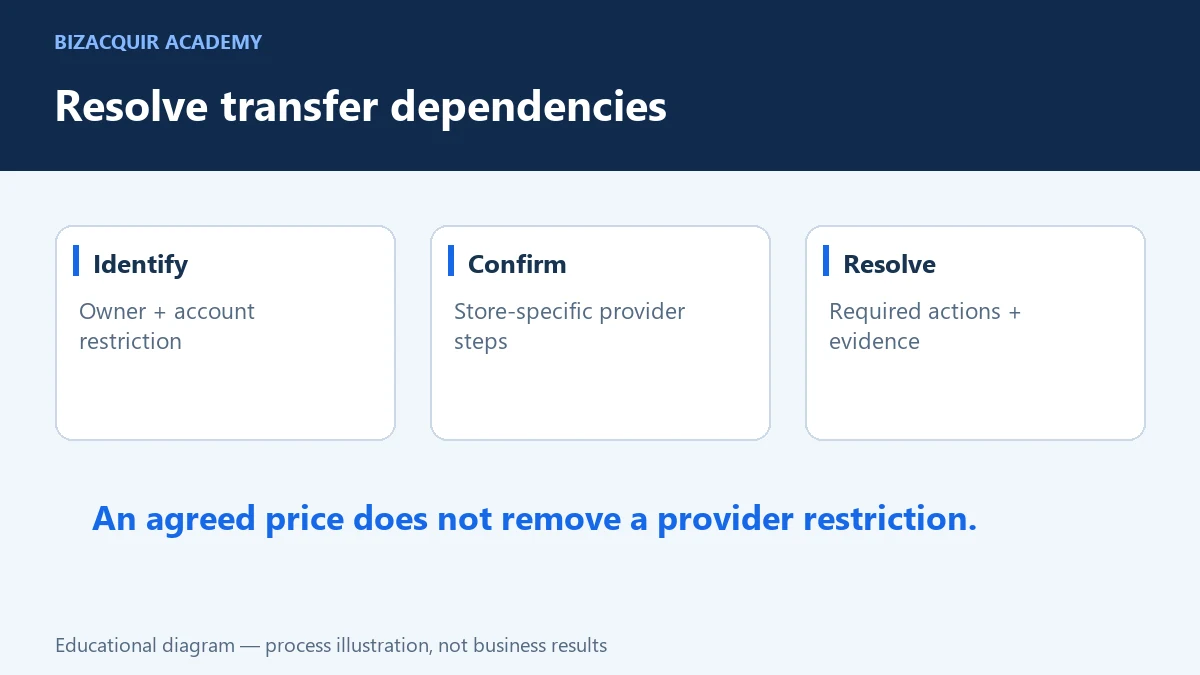
Use the ownership-transfer restriction guide for account-specific dependencies. A supported past-revenue history can qualify even with current zero sales; it does not guarantee a buyer, a restart cost or a sale price.
Your next practical step
Use the SHOPIFY selling checklist to turn the gaps into a preparation plan. You can start a private listing draft or explore a free valuation; signup or login is required to view valuation results.
Continue with Selling a Shopify Store With Past Sales but No Recent Revenue and Reopen or Sell Your Inactive Shopify Store? A Decision Guide.