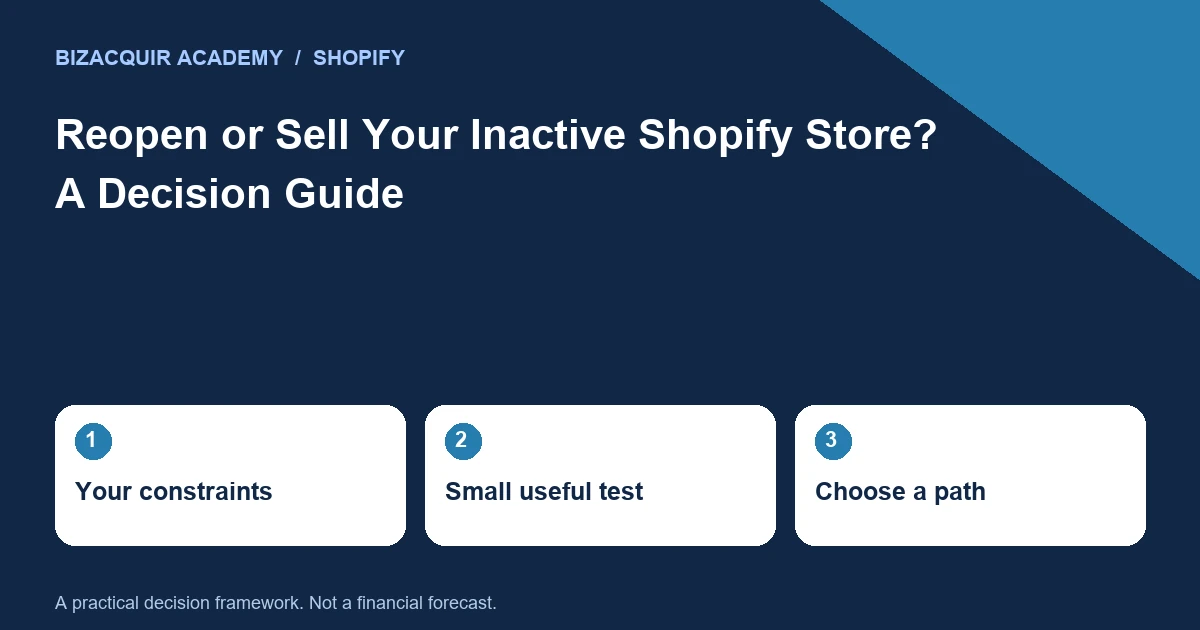
Reopening and selling are different projects. Reopening asks whether you want to operate the store again and can fund the work. Selling asks whether another owner can use the remaining business assets under clear terms. Neither decision should rest only on what you spent building it.
Set the decision boundary
Write down available time, cash you can afford to risk and the date by which you need a decision. These are personal constraints, not forecasts. Include ongoing obligations to customers and suppliers before allocating money to a new campaign. Confirm the store’s access and reactivation conditions using Shopify’s current guidance. Do not buy a plan, inventory or advertising just to make a sale listing look active. Any reopening expenditure should serve a defined test or operational need.
Compare the work required
| Question | Reopening | Selling |
|---|---|---|
| Product readiness | Can you fulfill new orders reliably? | Can a buyer understand the remaining work? |
| Cash requirement | Stock, tools, fulfillment and acquisition | Preparation, documentation and any agreed transition |
| Time | Ongoing operation | Diligence and handover |
| Evidence | Current demand and unit economics | Past revenue, assets, rights and obligations |
| Main uncertainty | Whether trading can restart economically | Whether a buyer values the transferable package |
Design a small informative test
If reopening is realistic, choose a test that answers a specific question, such as whether a supplier can still fulfill a product at a viable landed cost. Define the budget, stop condition and evidence you need before starting. Do not interpret clicks or enquiries as profitable orders. Hypothetical example: you have USD 1,500 available and estimate USD 900 for stock, USD 300 for tools and USD 300 for acquisition. If returns or fulfillment are not included, the budget is incomplete. A supplier-cost check may be more informative than spending the whole amount on advertising first.
Value the remaining assets without sunk-cost bias
The original design bill and past ad spend are not automatic resale value. Assess what a buyer can reuse today: domain, content rights, stock, supplier relationships and documented processes. Deduct the work or restrictions that limit that use in your scenario analysis. A store can have meaningful past revenue and still support only a cautious asset-based estimate. It can also lack enough information for a useful number. Treat uncertainty as a reason to gather evidence, not to select the highest available multiple.
Choose a path and preserve optionality
If you sell, prepare an inactive listing honestly rather than reopening just for appearances. If you reopen, keep records that would also help a later buyer: dated financials, operating changes and maintenance work. Either way, address outstanding customer obligations. BizAcquir’s free valuation can help structure the question; signup or login is required to view the private result. A marketplace submission remains a separate step requiring genuine past revenue and a successful financial connection. Use the Shopify selling checklist to identify missing preparation without committing to a sale or new spending.
Check the relevant provider guidance
These official references support the platform-specific steps. Your own contracts, account configuration and agreed sale terms still need to be checked.
Use a stop condition for a restart test
Choose a question whose answer could change your decision. For example, verify whether the supplier can still deliver at the proposed landed cost before buying stock. Define the budget and point at which you will stop the test; do not keep spending merely because the store once sold well.
Compare the actual preparation work for a sale with the ongoing work of reopening. Neither past design spend nor past advertising spend guarantees resale value. If you sell inactive, make the restart tasks and remaining customer obligations understandable rather than reopening just for appearances.
Your next practical step
Use the SHOPIFY selling checklist to turn the gaps into a preparation plan. You can start a private listing draft or explore a free valuation; signup or login is required to view valuation results.
Continue with Can You Sell a Dead or Inactive Shopify Store? and How to Prepare a Shopify Store for Sale.