An ecommerce store may now reach customers through AI shopping experiences as well as its familiar storefront. That creates a sale-preparation question: which channels are actually operating, what sales do the records support and what must the buyer maintain? A new distribution surface is not, by itself, an increase in business value.
Use current channel behavior, not an old launch announcement
Shopify announced Agentic Storefronts in December 2025 and documented a new admin home in May 2026. Its current help pages describe channel availability and management. Read the current help instructions before assuming every announced checkout experience is available to every store.
At the time of this guide, Shopify describes referral checkout for ChatGPT and supported direct-checkout experiences elsewhere. Eligibility and behavior vary. Record the channels actually shown for the store rather than advertising universal coverage.
Create a channel inventory
- In the authorized store admin, inspect the Agentic sales-channel area and record the available channels and their current state.
- Record the relevant product catalog, exclusions and any channel-specific restrictions.
- Identify where a customer completes checkout and which normal order, fulfillment and returns processes apply.
- Save the reporting period and the definition behind attributed sales. Distinguish referral and direct-checkout activity.
- Document the work required to maintain accurate product information and handle customer service.
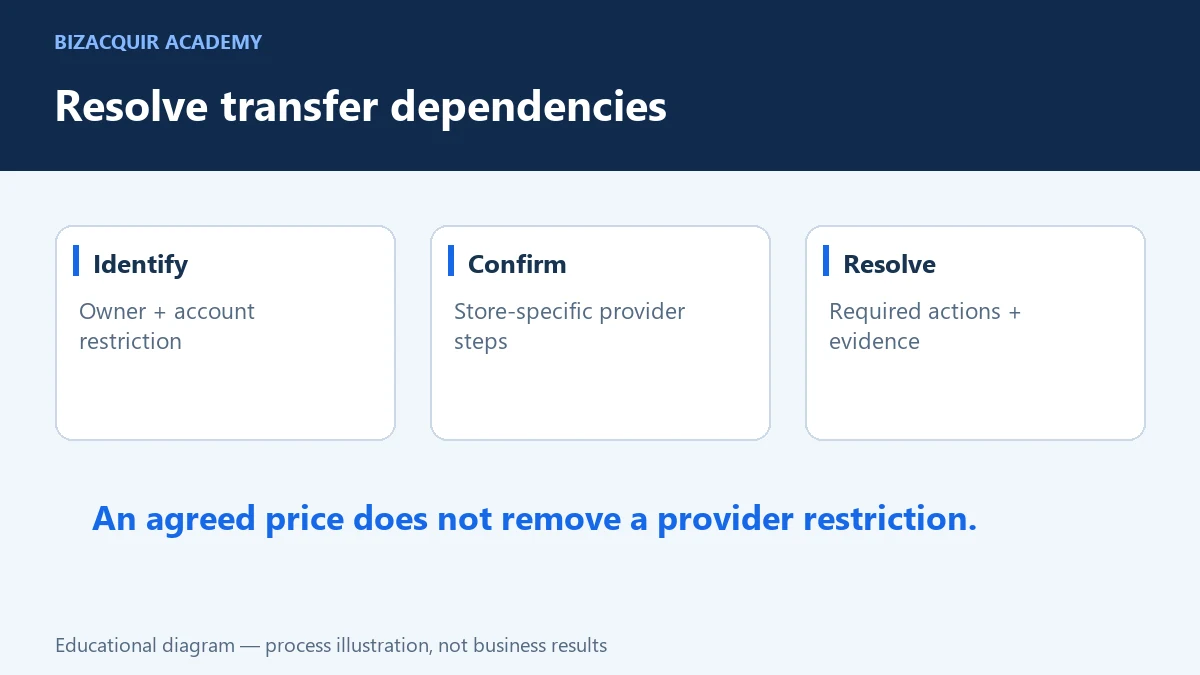
- Confirm any account-specific continuity questions with Shopify before promising a buyer that every setting or eligibility decision will transfer.
Do not add channel sales to store sales twice
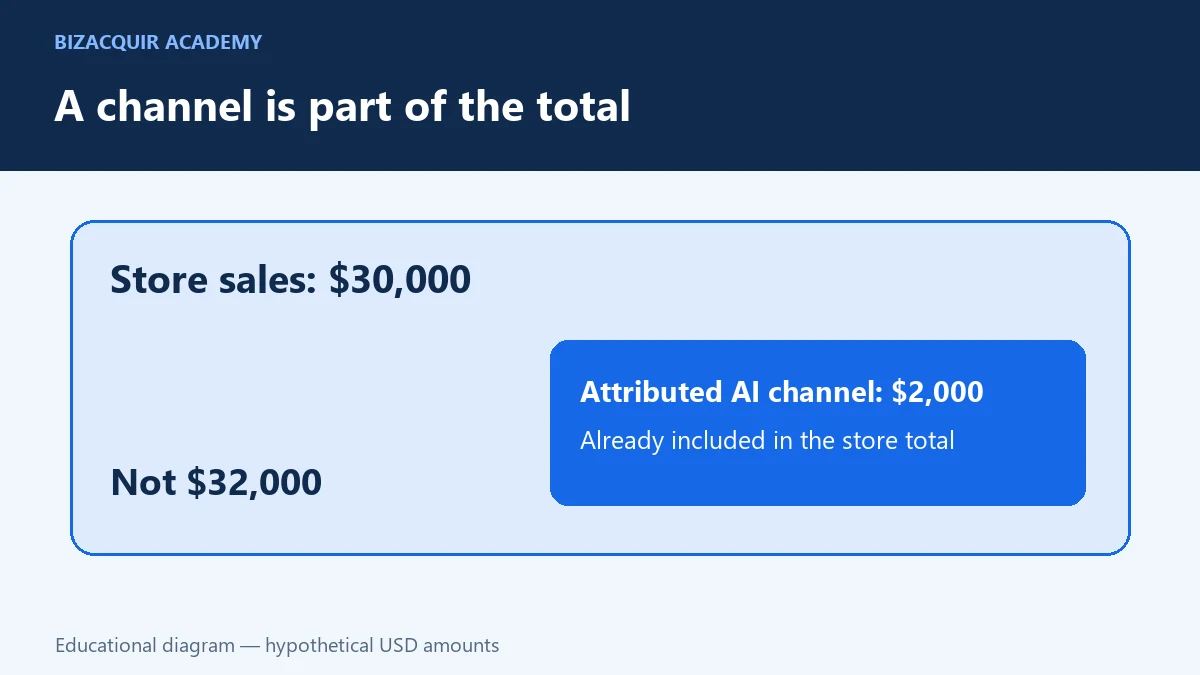
Hypothetical example: a store reports $30,000 of sales for a completed month, including $2,000 attributed to AI shopping channels. If that $2,000 is already part of the store total, the business did not make $32,000. It made the defined $30,000, with an attributed channel subset. Keep the provider’s sales definition visible.
Returns, discounts, taxes, shipping and payment timing can make different reports disagree. Reconcile their definitions before comparing margins. A rise in attributed sessions is not the same as a rise in successful orders, and neither alone proves incremental demand.
| Buyer question | Evidence to seek | Avoid claiming |
|---|---|---|
| Is the channel available? | The store’s current channel state and eligibility | Every Shopify store has the same access |
| Does it drive sales? | Dated order/report evidence with its attribution definition | A screenshot of a product in an AI answer proves sales |
| Is it profitable? | Relevant sales, returns, product and servicing costs | Channel sales are profit |
| Can it continue? | Catalog, operational dependencies and provider guidance | Ownership transfer guarantees every external channel relationship |
Treat reporting limits as limits
Shopify’s help documentation notes that parts of Agentic reporting are unavailable for headless stores. If that affects the business, say which evidence is missing. Do not turn absent session or conversion reporting into a zero conversion rate.
Record how channel attribution is generated and whether it covers the dates you are comparing. A newly enabled channel cannot support twelve months of historical claims. Keep the current incomplete month apart from completed periods.
Put catalog quality and obligations in the handover plan
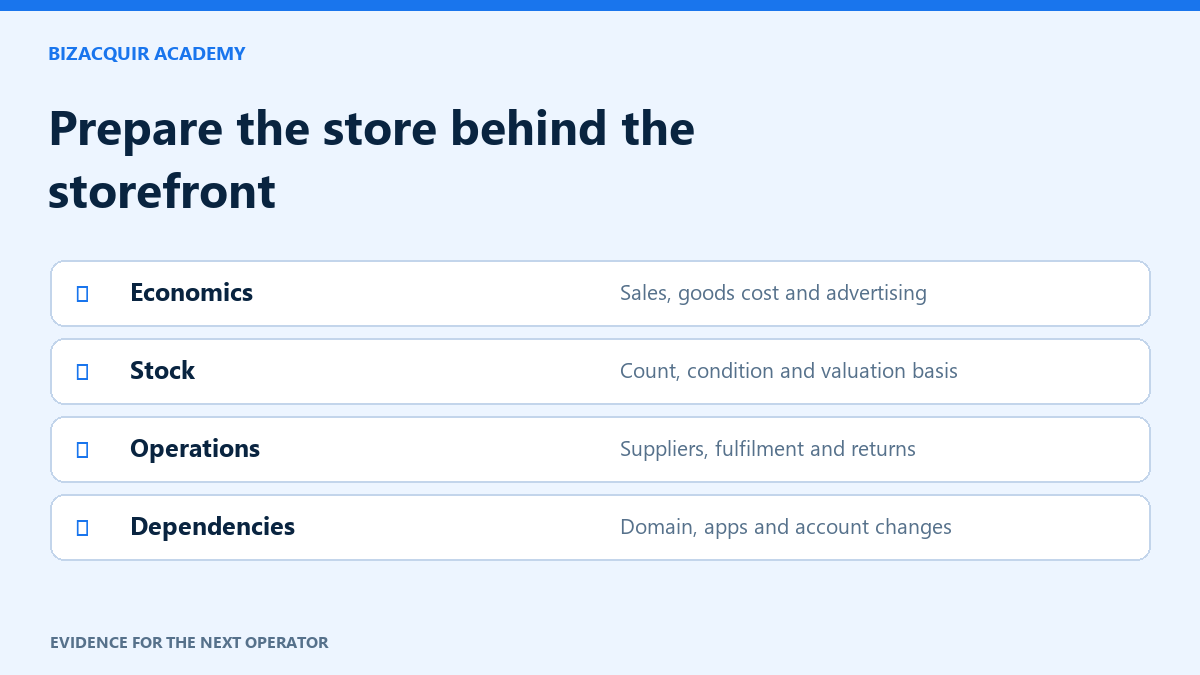
A buyer needs accurate products, prices, stock, shipping and returns information, not just access to a channel toggle. Assign responsibility for correcting stale product details and resolving orders placed around completion. Identify essential apps and fulfillment dependencies separately.
Document existing settings without publishing private admin screenshots or changing live configuration for a demonstration. A channel inventory can be a simple text table in the private sale pack. The seller should not provide passwords or customer exports in a public listing.
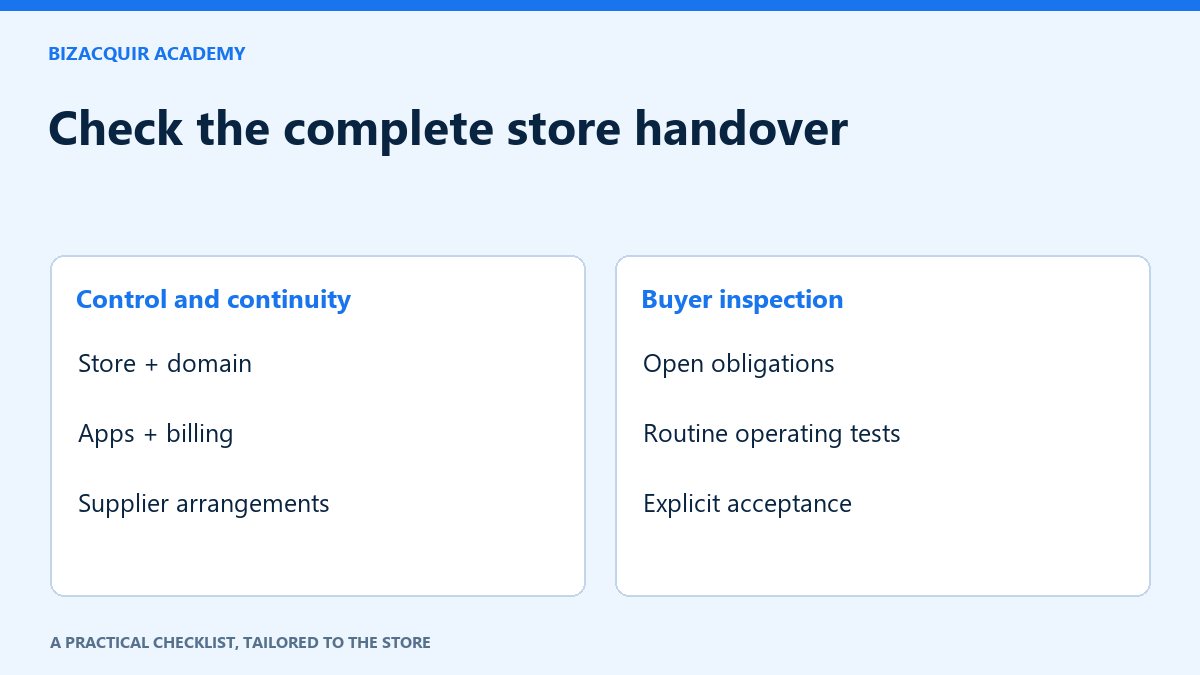
A practical pre-offer checklist
- The business has genuine sales history, with current trading stated separately.
- AI-channel activity is identified as a subset where appropriate, not added twice.
- Reported dates, currency and relevant sales definitions match.
- Missing analytics are disclosed without invented numbers.
- Catalog maintenance, fulfillment and support tasks have an owner.
- The proposed handover includes provider-specific questions still to resolve.
Use the evidence in the wider sale decision
A useful channel may diversify demand; a new or poorly measured channel may add uncertainty. Neither deserves an automatic valuation premium. Compare its contribution with the business’s established acquisition channels and the work needed to maintain them.
Use the Shopify sale-preparation guide and the store handover checklist for the wider operation. Sellers can prepare a Shopify listing; buyers can explore the buying process.
Sources and further reading
- Shopify: Agentic Storefronts
- Shopify: managing and reporting on Agentic Storefronts
- Shopify changelog: May 11, 2026
- Shopify: December 2025 announcement
Sources checked on October 23, 2026. Provider features and account eligibility can change; confirm the current options in your own account.