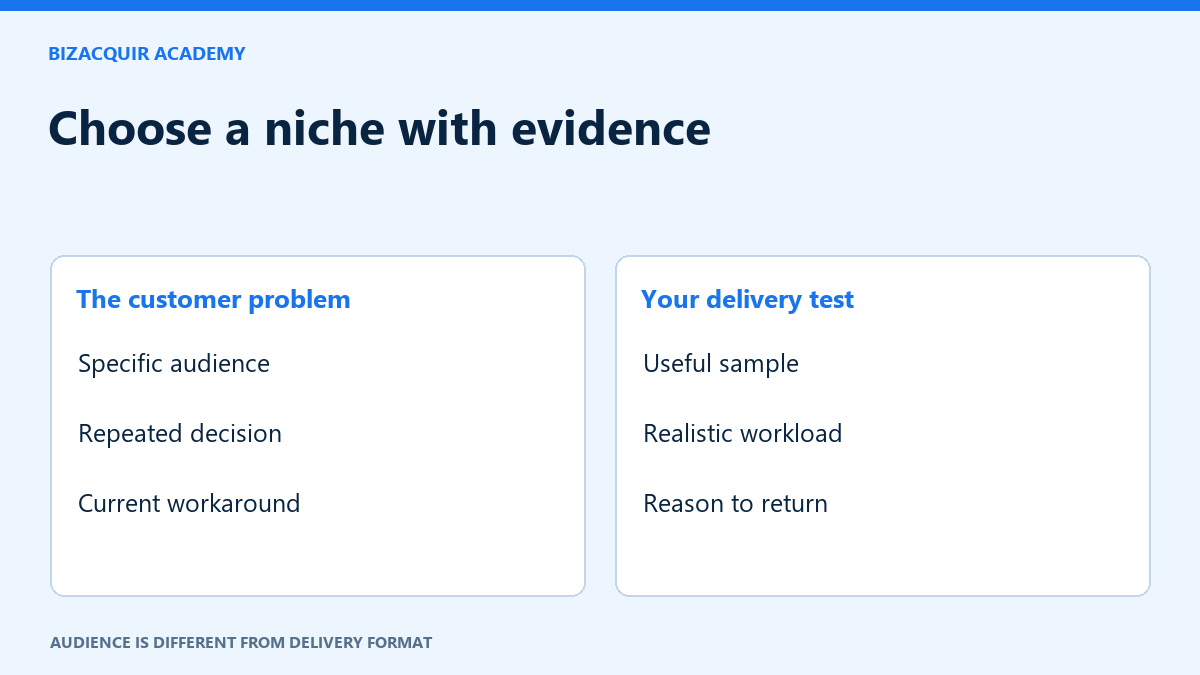
A useful niche is a group of people with a shared problem you can address repeatedly. “People interested in business” is too broad to design for. “First-time freelance designers learning to price client projects” gives you decisions to help with, examples to teach and a recognisable first customer.
Separate the audience from the format
Discord, courses, office hours and alerts are delivery formats. They are not the customer problem. Write the problem without mentioning software. Then decide whether members need ongoing help, time-sensitive information, structured lessons or a single tool. Whop supports paid-group experiences, but that does not mean every idea should become a group.
Look for a repeated job with a visible cost: wasted time, avoidable mistakes or difficulty applying information. Be careful with investment and trading communities. Do not promise returns, imply qualifications you do not hold or treat educational framing as a substitute for applicable rules.
Compare three ideas with the same scorecard
| Question | Evidence to collect |
|---|---|
| Does the problem recur? | Examples from different weeks, rather than one exceptional event. |
| Can you reach the audience? | Permission-based channels where the right people already participate. |
| What do they use now? | Existing tools, alternatives, workarounds and spending. |
| Can you deliver credibly? | A useful sample, relevant capability and realistic support capacity. |
| Why would they stay? | Fresh decisions or ongoing progress, not an artificially locked archive. |
Score each question from one to five only after collecting evidence. The numbers are a decision aid, not market research. A high total cannot rescue a serious safety, legality or delivery problem.
Interview for behaviour, not encouragement
Ask, “What happened the last time you tried this?” Follow with “How did you solve it?” and “What did that cost in time or money?” Avoid leading with your proposed membership. People may politely praise a concept they would never buy.
Record the language people use to describe the problem. If several interviewees want different outcomes, split the audience. A beginner learning product sourcing and an experienced reseller managing inventory might share a broad category but need different offers.
Run a small, honest pilot
Offer a narrowly defined workshop, short cohort or prototype resource with transparent expectations. State what exists now, what you will deliver and how feedback will be used. A paid pilot gives different evidence from a free waitlist; neither guarantees a durable subscription business.
Judge the pilot by whether the right people use the resource, ask relevant follow-up questions and want continued help. Do not equate a large chat membership count with paying demand. Keep free participants, trials and active paying members separate.
Make the final choice explicit
Write a one-page decision containing the audience, problem, recurring deliverable, exclusions, delivery cost and acquisition route. Also write a stop condition: for example, reconsider the format if members get all the value in a single session. Changing the format after learning is better than forcing a subscription onto a one-time need.
When listing a business later, choose the category that describes what it actually does. Platform, category and revenue model answer different questions. A Whop business can be a reselling community, an educational membership or a tool business; “Whop” alone does not identify its niche.
Use a comparison that can change your decision
Imagine you are considering a broad reseller chat, a weekly sourcing-review group for experienced resellers and a short course for first-time sellers. These are hypothetical options, not recommendations for a particular market. The broad chat may attract attention but be difficult to deliver distinctly. The review group has a recurring decision to support, but requires credible, current research. The course has a clear finish and may suit a one-time purchase better.
| Idea | Uncertainty to test | Useful pilot |
|---|---|---|
| Broad chat | What help would members pay for beyond free discussion? | A facilitated session on one repeated problem. |
| Sourcing reviews | Will experienced members use the review method repeatedly? | A worked evaluation with explicit costs and limitations. |
| Beginner course | Can learners complete a defined task independently? | One lesson with an observable exercise. |
Write down what evidence would make you reject each idea. If every outcome confirms your favourite idea, the test is not helping you choose.
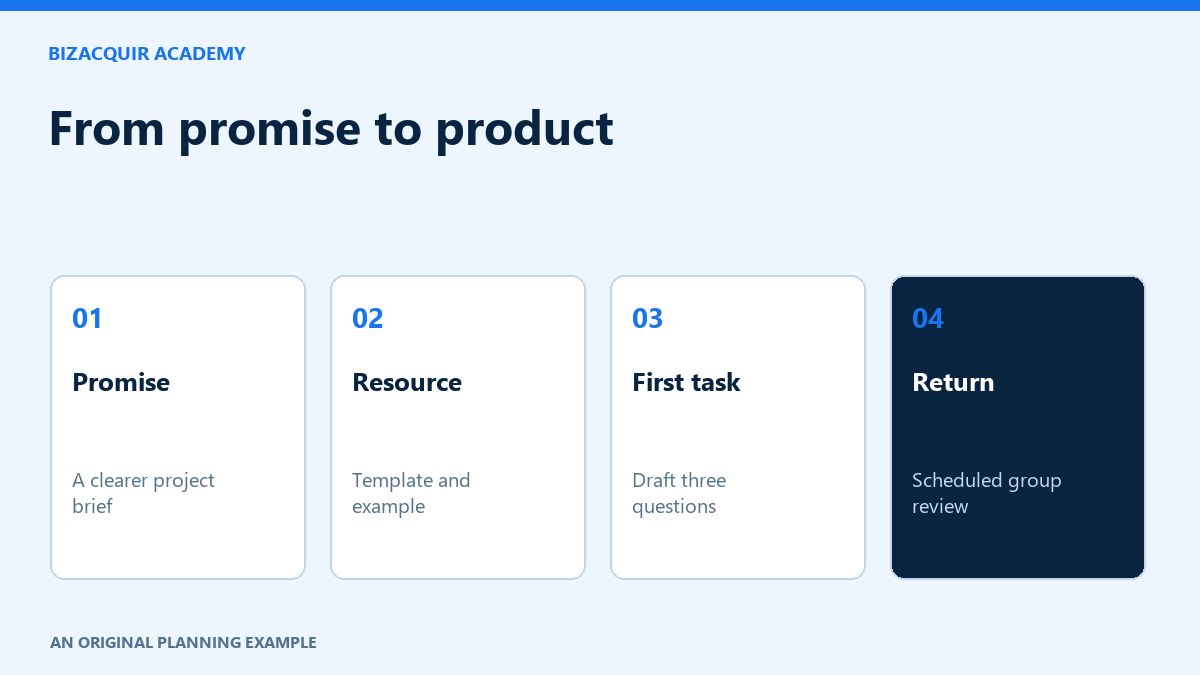
Turn interview notes into the first paid promise
- Group comments by the task people were trying to complete, not by the feature they requested.
- Separate urgent, repeated problems from interesting but occasional questions.
- Choose the task for which you can show a useful sample and sustain delivery.
- Write a concrete inclusion and exclusion list. Test whether someone outside your project can explain it back.
- Invite pilot participants using the same promise, then compare what they expected with what they used.
A common mistake is accepting every requested topic until the niche disappears. Another is treating follower count as proof of willingness to pay. If the pilot attracts curious free participants but no repeat use, change the offer or format before expanding the community. Keep the pilot's small sample visible in your conclusions rather than turning it into a demand forecast.
Your next step
- How to Start a Whop Business: From Offer to First Customers
- Grow a Whop Business Without Constant Discounts
Sources and useful references
Score a niche using evidence rather than enthusiasm
Compare two or three candidate niches on the problem, existing ways people solve it, your ability to deliver and whether useful service can continue without constant personal attention. Unknown demand is an unanswered question, not a positive score. A narrower audience with a specific recurring problem is easier to test than “anyone who wants to make money.”
| Check | Useful answer |
|---|---|
| Problem | Name the task or difficulty, not only a demographic. |
| Delivery | Describe the content, tool or service you can provide repeatedly. |
| Evidence | Separate conversations, trials and actual paid purchases. |
| Boundaries | Check rights and platform rules before promising access or outcomes. |