A profitable dropshipping or print-on-demand store can be a saleable operating business without a warehouse of stock. Its value still depends on something tangible: a working offer, reliable fulfillment, rights to the products and content, and customers the next owner can serve. A storefront template or an account history alone is not the same thing.
This guide is for the sale or purchase of a whole Shopify business with genuine past revenue. It is not a guide to buying a prebuilt store with no sales. Use the Shopify buying page to explore operating-business opportunities and the general diligence guide for the wider review.
Explain what the buyer is acquiring
List the brand, domain, Shopify store, product pages, original designs, advertising creative, operating instructions and supplier arrangements included in the sale. Mark exclusions explicitly. A design file is not proof that you own its commercial rights; retain the relevant creator agreements and licences for permitted private review.
For digital products sold alongside physical products, record where files are hosted, which licences apply and what access existing customers were promised. Shopify's digital-product documentation distinguishes downloadable files from externally hosted links. Test the actual delivery route; moving the storefront alone may leave content controlled by another account.
Rebuild the economics of a representative order
Select a completed ordinary month and a peak month. Reconcile sales after discounts and refunds, product or printing cost, shipping, payment fees, advertising, apps and support. Do not choose only the best-selling product or exclude unsuccessful campaigns that were necessary to generate the reported sales.
Hypothetical order example
A USD 40 order with USD 16 supplier cost, USD 6 shipping, USD 2 payment/platform cost and USD 10 attributed advertising leaves USD 6 before overhead, support, returns and taxes. If advertising cost rises to USD 14, that same calculation leaves USD 2. These are illustrative inputs, not market benchmarks or a forecast for any listed business.
Check which costs the seller's report includes. Shopify's profit-report guidance explains that recorded product costs matter. A product margin is not necessarily the profit of the whole operation. Preserve the original reports and explain any buyer planning adjustments separately.
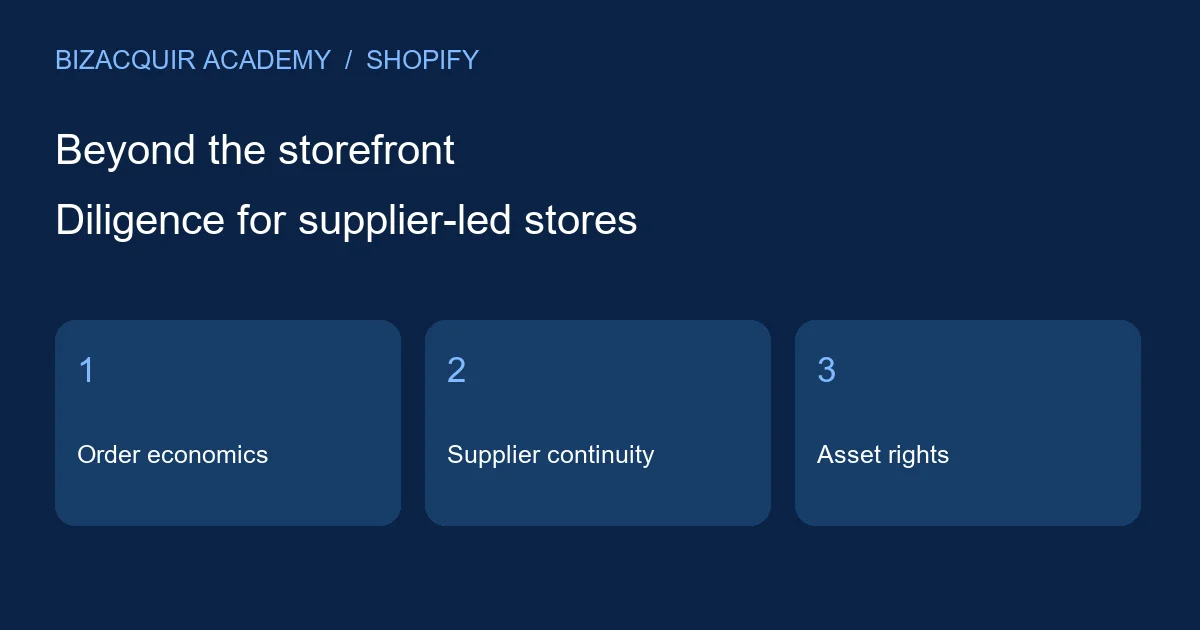
Test supplier dependence before making an offer
| Check | What to establish |
|---|---|
| Supplier relationship | Which entity holds the agreement, and whether buyer onboarding or consent is needed. |
| Price and terms | Current product, printing and shipping costs; minimums, credit terms and temporary discounts. |
| Delivery performance | Documented dispatch and delivery times, tracking gaps, defects and returns for a stated period. |
| Replacement options | Whether a substitute has actually been checked for product quality, cost and lead time. |
| Operational control | Who can change listings, routing rules, designs and customer notifications after handover. |
Review a permitted sample of completed orders with personal information removed. Trace order date, supplier acceptance, dispatch, delivery and any refund. Ask for explanations of outliers instead of assuming the median tells the whole story. A seller's informal assurance that a supplier will continue is not a transfer approval.
Plan provider-specific access correctly
Printful's current account-transfer guidance says the account itself cannot be transferred. Its supported store transition uses a new owner's account and a new integration, with products and print files manually re-added. Do not promise a password handoff as a substitute. Coordinate the actual sequence with the provider and the agreed transaction plan before disconnecting anything.
Other suppliers may have different arrangements. Record each provider's written requirements rather than applying Printful's process to all print-on-demand or dropshipping services. For Shopify itself, follow the current ownership-transfer instructions; payment, domain and supplier dependencies need separate treatment.
Evaluate the traffic behind the sales
Separate paid campaigns, organic search, returning customers, email and affiliate channels. Review the available history, not just current advertising screenshots. Identify whether performance relies on one creative, one influencer, a personal social profile or a short-lived product trend.
Ask who owns creative rights and what permissions are needed to continue using them. Do not assume a social or advertising account can be sold or transferred. Check the platform's rules and plan authorized business access where supported. An email list also carries consent and data-use obligations; do not upload it to a public listing or send it indiscriminately to prospective buyers.
Agree the order cutoff and responsibility for returns
At handover, some customers will have paid but not received their orders. Record open orders, supplier payments, in-transit goods, unresolved complaints and return windows. Agree which party performs the work and which funds cover it. A refund occurring after the ownership date can relate to an earlier sale.
Use the obligations worksheet and transfer checklist. For hybrid businesses holding stock, add the inventory worksheet. Do not count supplier-held stock as owned inventory without evidence of title and availability.
Make the final decision about an operation, not a screenshot
- Can the buyer serve existing customers under the proposed provider arrangements?
- Are earnings still plausible after realistic supplier, advertising and support costs?
- Are product and creative rights documented?
- Are open orders and returns allocated in the agreed terms?
- Can someone other than the founder run the routine workflow?
A missing answer can justify more diligence or a revised offer; it does not automatically prove the business is worthless. Sellers can begin with a free draft listing, then complete the required financial connection before submission. Buyers should keep enquiries and agreed handover steps in BizAcquir.