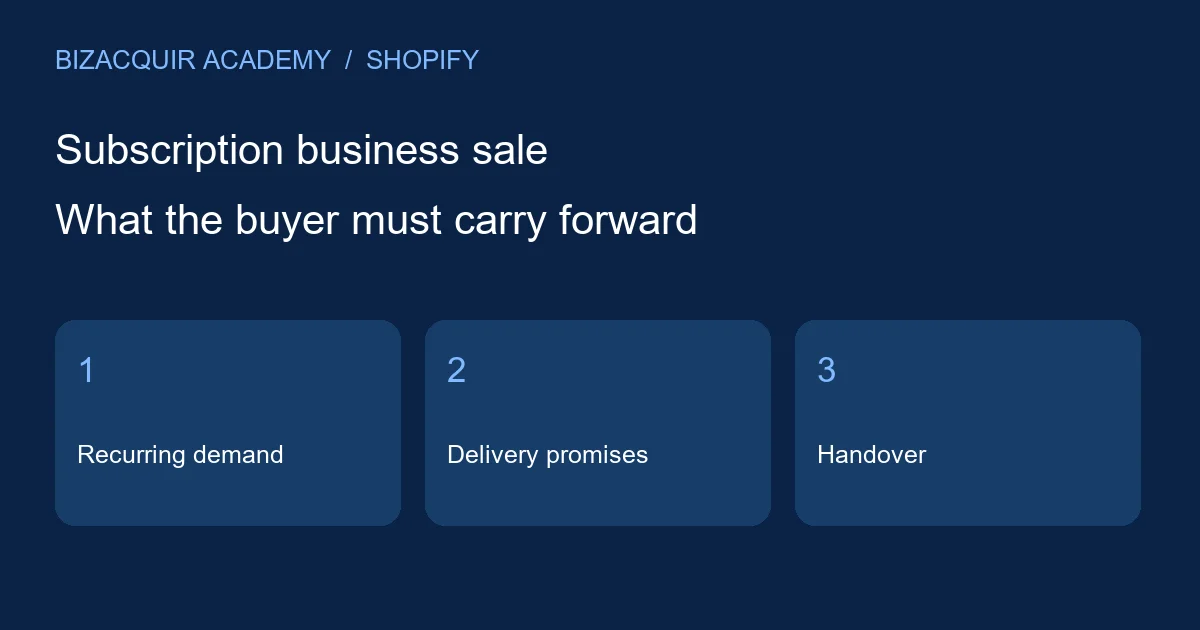
A subscription store is more than a list of repeat orders. A buyer is taking on a delivery promise: products must arrive, payments must work, and customers must receive the service they already paid for. This guide helps an operating Shopify business show both its recurring earnings and its remaining obligations before a sale.
Start with the general Shopify buyer due-diligence guide. Use the checks below when subscriptions, replenishment orders or prepaid boxes are a material part of the business.
Separate recurring demand from repeat purchases
A customer who orders twice is a repeat customer, not necessarily a subscriber. A subscription contract may exist even when its latest payment failed. Separate one-time orders, active paid subscriptions, paused arrangements, failed collections and cancelled contracts. Record an as-of date and the definitions used by the subscription app.
Build a monthly table covering opening paying subscribers, new subscribers, cancellations, reactivations and closing paying subscribers. Explain plan changes and pauses instead of forcing every change into churn. Then reconcile the money actually collected with refunds and sales reports for matching dates and currencies. Subscriber counts are not revenue, and annual cash receipts are not monthly recurring revenue.
Shopify explains how to identify subscription sales in reports. Keep the export filters with your evidence. A subscription dashboard is useful, but it does not include every cost of operating the store.
Show the obligation attached to prepaid revenue
For each prepaid plan, record the service period, shipments already delivered, shipments remaining, estimated delivery cost and cancellation terms. Aggregate this for early buyer discussions; do not publish customer names, payment details or individual contracts in a listing.
Hypothetical prepaid-box example
Suppose 100 customers each prepaid USD 120 for six monthly boxes. Two boxes have shipped, leaving 400 boxes to deliver. At an assumed USD 9 product, packaging and shipping cost per box, estimated remaining fulfillment cost is USD 3,600. That excludes support, refunds and overhead. The original USD 12,000 receipt is not all available profit, and this calculation does not prescribe how buyer and seller must allocate the obligation.
Prepare a second scenario with the documented higher supplier or shipping cost. Agree which party funds outstanding fulfillment and how a later refund is handled. Keep those terms in the agreement rather than assuming the business price settles every obligation.
Check retention without hiding discounts or failed payments
| Question | Useful evidence | Why it matters |
|---|---|---|
| Who renewed at the normal price? | Cohorts separated by introductory offer and renewal date | Discount-led acquisition can conceal weak renewal demand. |
| What did cancellations remove? | Lost customers and lost recurring revenue, separately | Losing a high-value plan differs from losing a low-value plan. |
| Were collections successful? | Failed, recovered and still-unpaid invoices or orders | An active label does not prove cash collection. |
| What is concentrated? | Share of sales by plan, product and acquisition channel | A single offer or paid campaign may carry most of the operation. |
Use the opening cohort as the denominator when calculating retention. Do not include newly acquired customers in a renewal rate or average monthly percentages without their underlying populations. If history is incomplete, show the available period and the missing months.
Map the subscription system before changing ownership
List the subscription app, payment gateway, fulfillment provider, notification tools and any custom integration. Identify the contract owner and the action each supplier requires for a business sale. Store ownership, app access and billing authorization are different items; an accepted Shopify ownership invitation does not establish that every supplier contract has moved.
Shopify's subscription considerations describe supported payment gateways and warn about data deletion after uninstalling a subscription app. Do not uninstall an app merely to demonstrate a clean handover. Ask the app and payment provider for their supported transition path before any change.
- Document the current configuration and permitted reports.
- Confirm the buyer can use the relevant app and payment arrangement.
- Agree who handles renewals, failed collections and refunds across the transition.
- Schedule the change around known billing and dispatch dates.
- Test authorized access and the agreed workflow without creating duplicate customer charges.
Prepare a handover the buyer can operate
Give the buyer a dated dispatch calendar, supplier lead times, stock and packaging requirements, support templates and exception procedures. Show what happens when a shipment is late, a payment fails or a subscriber changes address. A written process should identify the responsible person rather than rely on the founder's memory.
Use the prepaid orders and obligations worksheet to record the unresolved items. Keep completed copies private. Pair it with the transfer plan so each promise has an owner, date and acceptance check.
Common mistakes before a subscription-store sale
- Calling all repeat orders subscriptions.
- Presenting cash received as profit without the cost of future deliveries.
- Using the latest subscriber count as a substitute for retention history.
- Promising that payment credentials or app contracts transfer automatically.
- Making live billing changes before both parties have agreed the transition.
Resolve unclear records before selecting an asking price. The Shopify valuation guide helps organize the earnings basis; its estimate is not a guaranteed offer. When ready, prepare a free Shopify listing. A genuine successful financial connection is required before first submission.