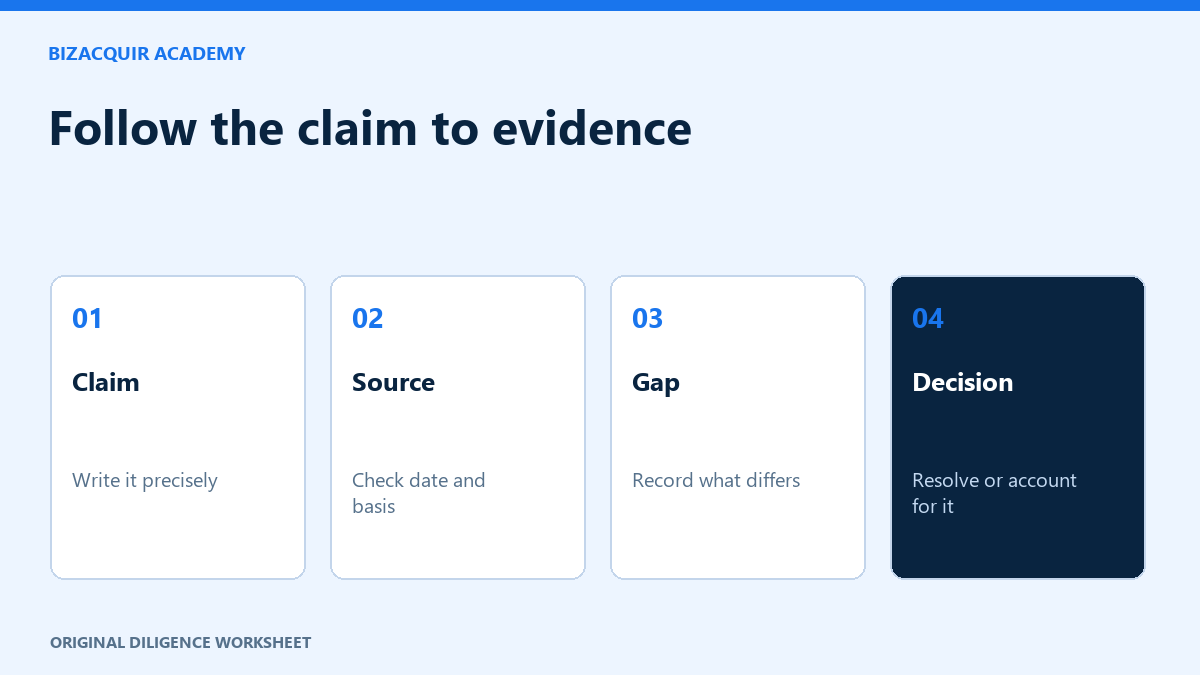
A good diligence question connects a claim to evidence and a decision. “Is the business good?” is too broad. “What proportion of these paying members renewed, using which definition and period?” is a question a seller can answer and a buyer can evaluate.
Start with a claims-and-evidence log
| Claim | Evidence to request | Question to resolve |
|---|---|---|
| Recurring revenue | Plan mix, subscription states and period-specific source records. | How much is recurring, collected and discounted? |
| Operating profit | Costs and reconciliation to recorded results. | Is replacement owner work included? |
| Engaged community | Aggregated usage and retention data. | Are these paying members or all members? |
| Easy handover | Asset register and provider requirements. | What needs consent or a new agreement? |
Mark unresolved questions explicitly. A missing answer is not a zero, and a persuasive screenshot is not the same as complete access to the underlying period.
Reconcile the financial story
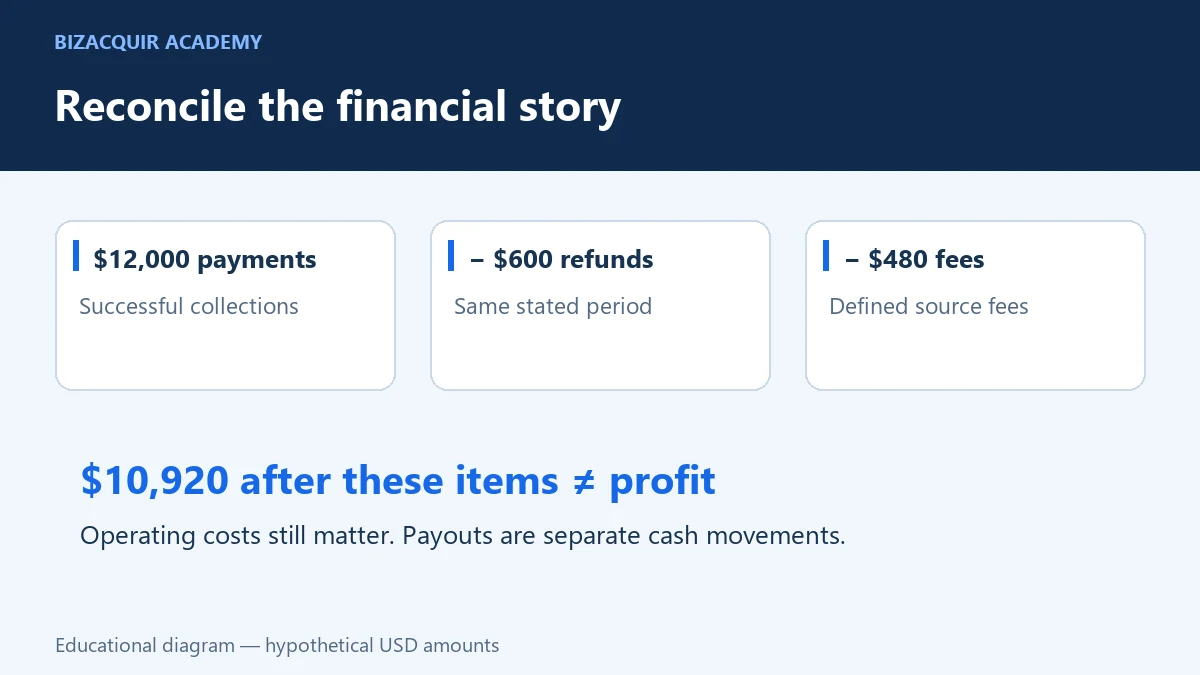
Compare completed months with completed months. Separate subscriptions from one-time sales and distinguish refunds from disputes. Ask whether the same activity appears in Whop and Stripe; adding two sources can double-count one business.
Check the economic impact of annual plans and services owed after completion. A recent cash collection can carry a future delivery obligation. Ask what costs and customer commitments the buyer is expected to assume.
Understand why members stay
Review the offer, sample content and actual delivery cadence. Ask how much depends on the seller’s personal reputation, relationships or specialist knowledge. Request aggregate cohort information where available rather than private customer data that is unnecessary for the decision.
Read cancellation reasons in a privacy-preserving summary. Distinguish failed-payment exits from dissatisfaction. If acquisition comes mainly from one social account, confirm whether that account is included and whether its platform permits the proposed transfer.
Check control and transferability separately
Identity verification concerns a person. A data connection concerns a source. BizAcquir Vetted concerns recorded listing review. None automatically proves that every included asset can be transferred.
Ask for the domain, content, software and service ownership picture. Where an account change needs provider approval, make that dependency explicit before agreement. For Whop, request account-specific guidance instead of assuming that inviting another team member transfers the entire business or its payment relationships.
Turn findings into conditions and a handover test
Define what must be clarified before agreement and how delivery will be checked later. A test might be “buyer can administer the agreed community using their own authorised account” rather than “seller sent login details.” Specify the required asset version, documents and exclusions.
In BizAcquir’s assisted workflow, the buyer explicitly accepts the agreed handover; a receipt upload or elapsed inspection time is not acceptance. Keep questions, agreed changes and evidence in the permitted workspace. Seek professional advice for material legal, tax or contractual uncertainty before committing funds.
Finally, write down why the acquisition still makes sense if the optimistic case does not happen. The purpose of diligence is to decide whether the price and obligations suit you, including the option to decline.
Follow one discrepancy all the way through
Suppose a hypothetical listing says USD 5,000 monthly revenue, a payment screenshot shows USD 4,700 and the bank record shows USD 4,200. Do not immediately assume either fraud or a harmless fee difference. Ask which period, currency and event each figure measures. Refund timing, fees, reserves, other payment sources or an incomplete period could explain part of the gap; only records can establish which explanation is true.
- Write the claim exactly, including its dates and definition.
- Request the least intrusive evidence that could reconcile it.
- Record the seller's explanation alongside the evidence, not instead of it.
- Identify the amount still unexplained and what it changes in your valuation.
- Resolve the gap or make your decision with that uncertainty explicit.
Prepare questions that change the purchase decision
- Which part of the offer would members lose if the current owner stopped participating?
- Which annual subscriptions have been paid but still require future delivery?
- What recurring costs are absent from the headline profit calculation?
- Which provider or supplier must approve a transfer?
- Which acquisition channel would still work without the seller's personal account?
- What practical task will prove that the buyer can operate each critical asset?
Choose a few material questions at a time instead of sending an indiscriminate request for all customer data. A documented uncertainty can become a condition to resolve before agreement. It should not become a made-up adjustment that makes your preferred price look correct.
Keep a final decision log: what you confirmed, what remains uncertain, what the downside would mean for you and why you are proceeding or declining. Evidence from one strong month should not erase a weak operating history or an unresolved account dependency.
Your next step
- What to Include in a Whop Business Sale
- Annual Memberships in a Whop Sale: Remaining Service Obligations
Sources and useful references
- Whop: user and membership distinctions
- Whop: account-specific support
- BizAcquir: assisted transaction guide
Turn diligence findings into an actionable question
Replace “send proof of revenue” with a dated, specific request: for example, ask how the listed monthly series reconciles to the stated source after refunds. Replace “is it passive?” with the tasks and hours needed to keep the service running. Request minimized evidence for the question rather than unrestricted account access.
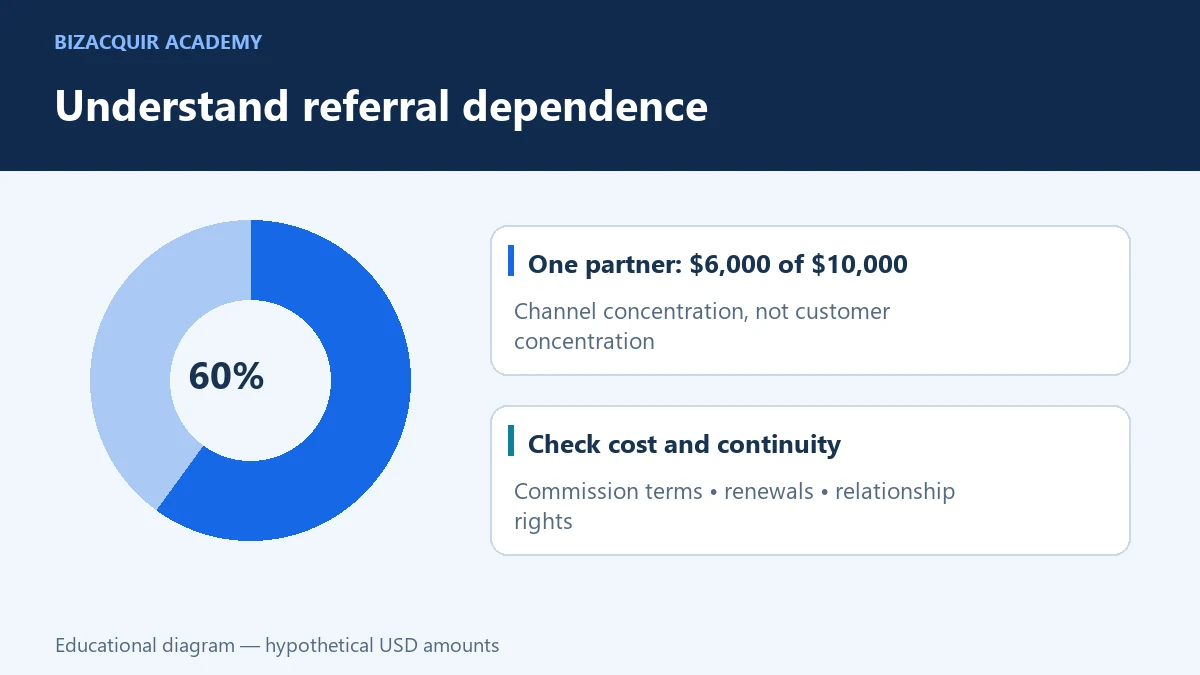
If a large share of revenue comes from promoters, use the affiliate diligence checklist. Record an unresolved relationship as a dependency; do not assume a new owner inherits it.