A Whop business can have genuine customers and still depend heavily on one promoter. A buyer needs to know which demand belongs to the business, what it costs to acquire and whether the relationships can continue after a sale. The useful question is not “Does it use affiliates?” but “What would change under a new owner?”
Identify the affiliate arrangement before measuring it
Whop documents both general affiliate settings and custom arrangements. A seller may have different terms for particular partners or products. Inspect the actual agreement, not a platform default or a percentage remembered from launch.
Keep product referrals separate from programs that reward someone for bringing a business onto a platform. They have different economics. Record what generates the commission, who is owed it, when it becomes payable and whether it applies once or to recurring purchases.
| Item | What to record | Why it matters |
|---|---|---|
| Customer source | Affiliate, organic, paid advertising or unknown | Unknown attribution should not be called organic |
| Commission basis | Revenue definition, rate and duration | A percentage without its basis is incomplete |
| Concentration | Share from the largest partners over matching dates | Several links may still belong to one promoter |
| Continuity | Written terms, contact relationship and consent needed | Past promotion does not promise future promotion |
| Adjustments | Refund and dispute treatment | A sale may later reverse or change the economics |
Measure revenue quality as well as referral volume
Compare cohorts on renewal, refunds and contribution after commissions. Ten new subscriptions are less informative than whether those members remain and what they cost to support. Use the same observation window for each cohort; a two-week cohort cannot fairly be compared with members retained for six months.
Tracking links help distinguish campaigns, but attribution can be incomplete. A customer may encounter a creator, return through another link and purchase later. Keep “unknown” as a real category instead of reallocating it to the channel that makes the business look best.
Hypothetical example: gross revenue hides the dependency
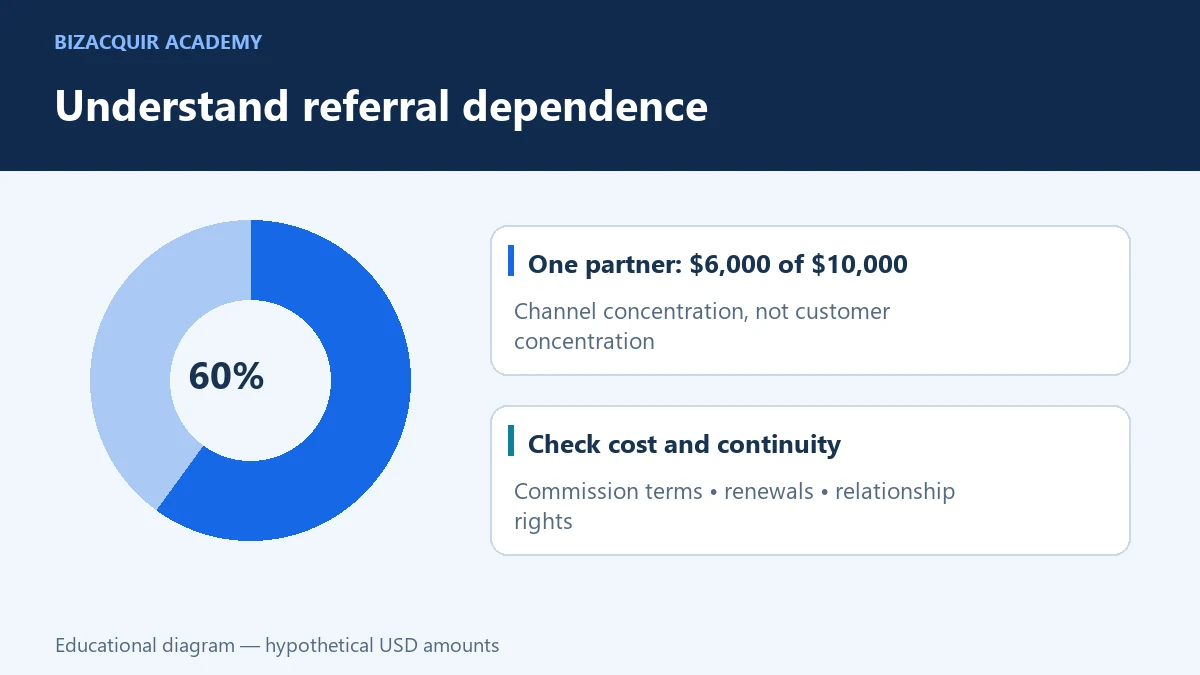
Assume a completed month has $10,000 of successful payments before refunds. One affiliate is attributed $6,000. At an agreed 25% commission on that stated basis, the associated commission is $1,500. The remaining $8,500 is not profit: refunds, delivery costs, other marketing, fees and operating expenses are still relevant.
Now model the loss of half that partner-attributed volume. Holding other revenue constant would reduce gross payments by $3,000. Some variable commissions could fall too, while fixed staff costs may remain. This is a sensitivity test, not a forecast. State the assumptions rather than claiming the business would definitely lose exactly that amount.
Ask these questions before agreeing terms
- Which partners produced sales in each completed month, and are multiple identities controlled by the same person?
- Do current agreements cover repeat payments, refunds, chargebacks or minimum commitments?
- Does the business own the advertising content or merely have permission to use it?
- Will the partner continue with a new owner, and has that been discussed without promising an unapproved arrangement?
- Can the buyer operate the offer without the founder’s personal audience?
- What happens to commissions already earned before completion? Record the agreed treatment rather than assuming they disappear.
Turn weak evidence into a useful sale preparation task
If a partner is known only through informal messages, collect the existing terms and clarify the commercial relationship before describing it as transferable. Do not create a new commission promise simply to make a listing attractive.
If source reporting is incomplete, present the available window and explain the gap. A buyer may request a longer observation period or make an offer conditional on defined evidence. That is more useful than inventing an industry-standard concentration discount.
Find businesses to compare thoughtfully
On Browse Businesses, select Whop and use the category, budget and operating-status filters to narrow your shortlist. A listing summary is the start of diligence, not a substitute for the checks above.
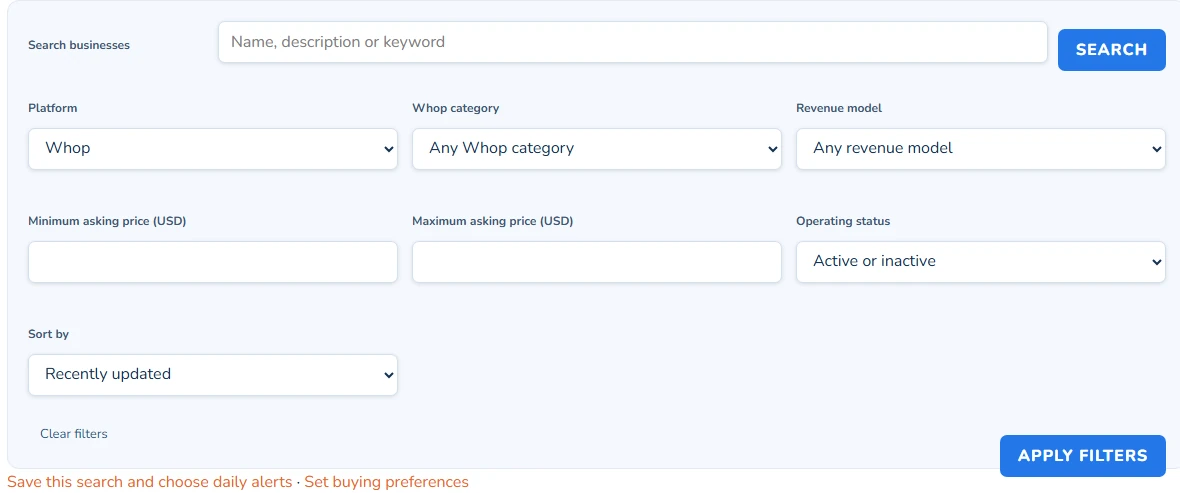
Actual public BizAcquir filter interface, captured October 23, 2026. No seller identity or private financial data is shown. Open the image larger to read the controls.
Plan the handover without assuming a platform switch transfers contracts
List referral links, permitted creative assets, reporting access and outstanding obligations in the asset schedule. Confirm the supported account and access process separately. A business sale agreement cannot force an unrelated promoter or provider to accept a new counterparty.
Use the founder-transferability guide for personal audience dependence and the negotiation guide to compare the whole offer. Buyers can explore Whop business listings; sellers can prepare a free listing.
Sources and further reading
Sources checked on October 23, 2026. Provider features and account eligibility can change; confirm the current options in your own account.