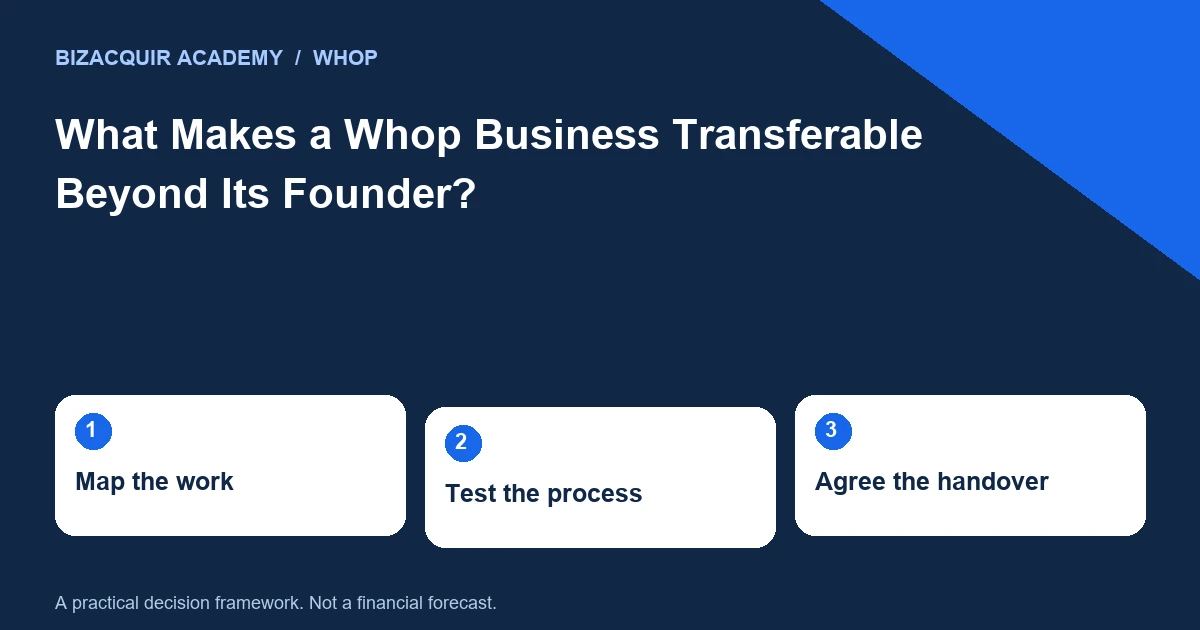
A business is not independent of its founder simply because its checkout runs automatically. Buyers need to know who delivers the value, who controls the assets and whether essential work can continue after the seller leaves.
Map the founder’s weekly contribution
For two representative weeks, record tasks rather than just total hours. Include public appearances, private support, product updates, moderation, sales calls, partnership management and emergency fixes. Identify which tasks require your personal reputation or specialist knowledge. Group the list into documented tasks someone else can perform, tasks requiring training, and activities inseparable from you. The third group deserves an explicit discussion, not a promise that a new owner will “figure it out.”
Test a handover before promising one
Choose one recurring process and ask an authorized team member to follow the instructions while you observe. Record where they need clarification. Improve the document and repeat with a different task. This gives you practical evidence of operational readiness without exposing credentials to a prospective buyer prematurely.
| Dependency | Useful preparation | Remaining question |
|---|---|---|
| Founder livestream | Format, schedule and content archive | Will members accept another presenter? |
| Private supplier relationship | Written terms and introduction plan | Does the supplier consent? |
| Custom automation | Runbook and technical owner | Can the buyer maintain it? |
| Moderation | Rules and escalation examples | Will the team remain? |
Separate access from ownership
An invitation can grant access without transferring an asset or contract. List the legal owner, day-to-day controller and proposed transfer route for every essential item. Whop documents role-based team access; use the supported process appropriate to the asset and confirm business ownership changes separately. A password handover is not a substitute for a sound transfer plan. For content, check contributor rights and licences. For a personal social account, do not assume that a business sale permits its transfer. State exclusions plainly and explain how the buyer could operate without them.
Define transition work in deliverables
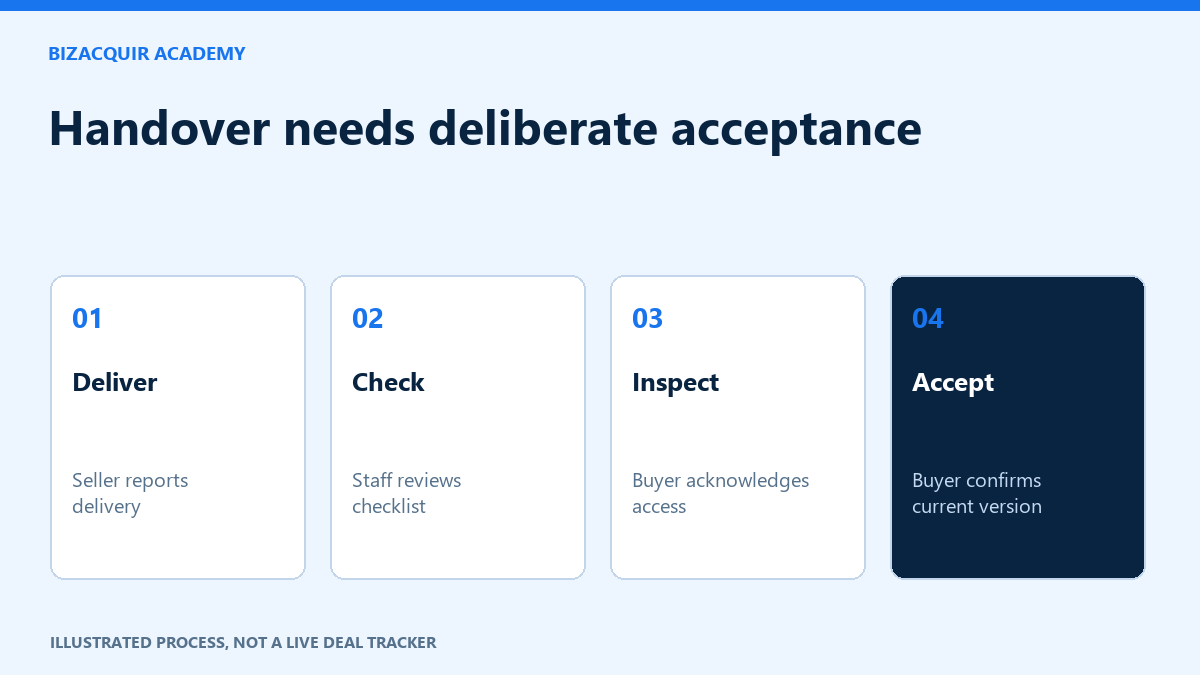
“I will help for a while” creates different expectations. A useful proposal identifies training sessions, documentation, introductions, delivery dates and the boundary of further support. These are negotiated terms, not automatic BizAcquir service promises. Hypothetical example: instead of promising unlimited help, a seller proposes three recorded training sessions, a moderation runbook and introductions to two contractors. The buyer asks for a deployment walkthrough too. The final checklist should include the agreed addition before acceptance; it should not remain in an informal side conversation.
Present dependence honestly in your listing
Show owner hours and essential skills with the period observed. Explain who handles absences, whether staff have agreed to stay and what has not yet been tested. Do not describe volunteers as contracted employees or count an unaccepted invitation as a retained team. Your goal is not to claim the business runs itself. It is to make the buyer’s future workload visible. Use the handover checklist to connect every important promise to a transferable asset, a responsible person and a way to check completion.
Check the relevant provider guidance
These official references support the platform-specific steps. Your own contracts, account configuration and agreed sale terms still need to be checked.
Use a two-week absence scenario
Without changing live customer service, write down what would happen if the founder were unavailable for two weeks. Which deliveries can the current authorized team complete? Which renewals, support decisions or launches would stop? Use the answers to define training and missing coverage, not to claim the business is founder-free.
If partner promotion depends on the founder personally, add affiliate continuity to the review. Do not penalize the same dependency separately in every valuation adjustment.
Your next practical step
Use the WHOP selling checklist to turn the gaps into a preparation plan. You can start a private listing draft or explore a free valuation; signup or login is required to view valuation results.
Continue with What to Include in a Whop Business Sale and How to Plan a Whop Business Handover.
Run a small absence test before promising independence
Choose one recurring task with a clear outcome: welcoming a member, preparing a scheduled lesson or answering a routine support question. Write the steps and give an authorized operator only the access needed. Let them perform the task without coaching, then record the result and any missing decision or permission.
Hypothetical example: a founder spends six hours a week on onboarding. A colleague follows the new checklist but still needs the founder to approve every exception. The routine process is documented; exception handling remains founder-dependent. Record both facts instead of advertising a fully passive business.
Repeat for moderation, content, reporting and service interruptions. Separate transferable instructions from personal reputation and legal rights. A buyer cannot inherit a founder’s reputation merely by receiving account access.
Open the printable task and absence-test worksheet · Download editable CSV. Keep your completed copy private.
Pair this with the asset ownership register and the Whop handover plan.