A cancellation is an event; its cause is a question. Members can leave because their task is complete, the product disappoints, their budget changes or payment fails. Treating all departures as a need for another discount hides useful information.
Choose and name your churn definition
A simple cohort measure is the number of paying members from the opening cohort who leave during the period, divided by paying members in that cohort at the start. Exclude new joins from that denominator. Keep the period and definition alongside the result.
Hypothetical example: 100 paying members begin the month and 8 of those leave. Opening-cohort member churn is 8%. If 20 new members join, the business can still grow while losing part of the original cohort. Growth and retention answer different questions.
Whop’s documented dashboard churn uses its own definition: churned users over the past 30 days divided by active users 30 days ago plus new users during that period. Do not compare that percentage directly with the opening-cohort calculation without explaining the difference.
Separate voluntary and payment-related departures
Review available membership statuses and failed-payment information. A failed charge is not the same as a member deciding the community is unhelpful. Equally, a scheduled cancellation may still have access until the billing period ends. Use a consistent event date for each measure.
For payment problems, direct members to the provider’s supported billing and support routes. For voluntary cancellation, offer a short optional reason question. Do not make cancellation deliberately difficult or hide the exit behind repeated sales conversations.
Inspect the member journey by cohort
| Pattern | What to investigate |
|---|---|
| Early cancellations | Offer mismatch, access errors or a confusing first task. |
| Departures after one topic ends | A finite need sold as an ongoing membership. |
| Long-time members leaving | Changing needs, repetitive delivery or reduced relevance. |
| One acquisition channel underperforming | Promises that attract the wrong audience. |
Group members by join month or acquisition source when reliable data is available. Avoid conclusions from tiny samples and avoid publishing identifiable member-level records.
Choose one intervention with a plausible cause
If members cannot find the first lesson, simplify onboarding. If they need feedback but receive only an archive, revise the offer or delivery. If experienced members have outgrown beginner content, a progression path may help more than a cheaper renewal.
Record what changed, when it changed and which cohort experienced it. Allow a full comparable observation period before judging the result. Watch support effort and refunds as well as retention: retaining everyone at an unsustainable service cost is not an improvement.
Prepare honest retention records for a future buyer
Keep member counts, paid subscriptions, revenue retention and refunds distinct. Explain pauses, reactivations and plan migrations. A screenshot of total members cannot establish recurring revenue, and a reduced churn percentage cannot establish profit. A buyer should be able to understand the calculation without relying on your interpretation of a dashboard colour.
Work through a retention diagnosis
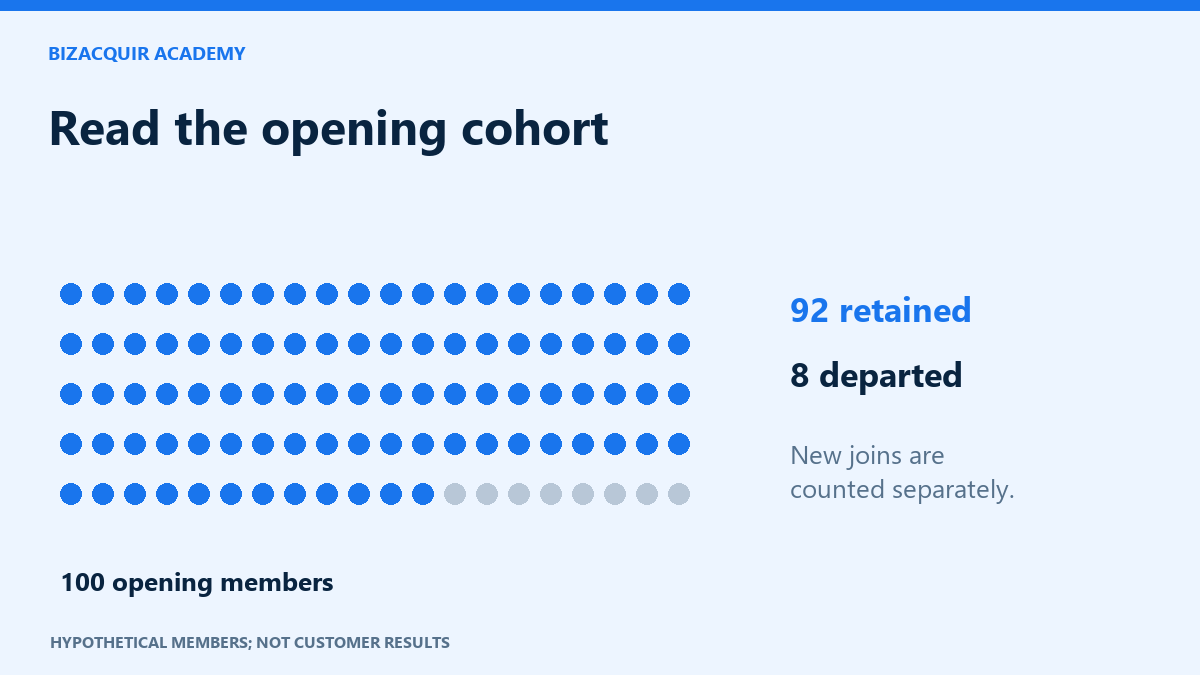
Take an illustrative opening cohort of 100 paying members. During a completed month, eight of those members stop paying: three following payment problems, three saying they could not find useful material and two saying their project ended. Twenty new people join during the month. The opening cohort retains 92 people, so its member retention is 92% and churn is 8%. The new joins do not enter that cohort's denominator.
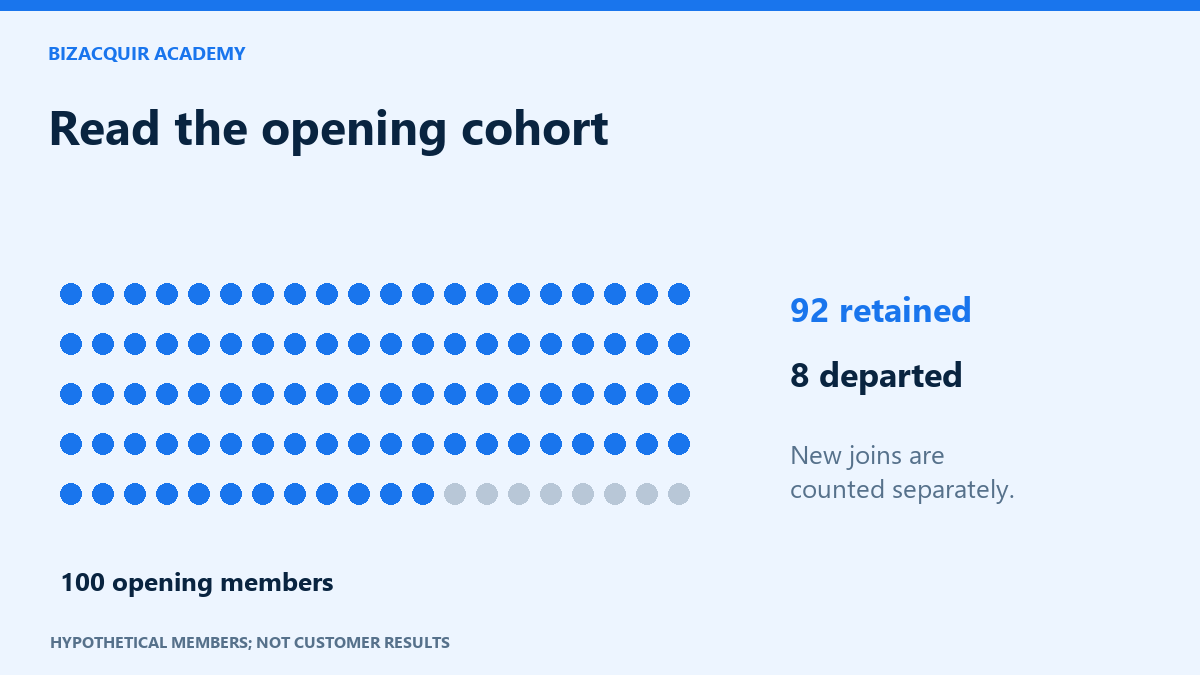
Original hypothetical cohort diagram: 100 opening members, 92 retained and eight departures, with new joins counted separately.
The reason breakdown suggests different responses. Review supported billing recovery for the three payment problems. Test the welcome route for the three access/value problems. Ask whether the product was ever intended to serve the two completed projects beyond their original task. Offering everyone the same discount would not distinguish these causes.
Compare changes without fooling yourself
Suppose the next opening cohort contains only 25 people and one leaves. Its 4% churn looks lower, but a single additional departure would make it 8%. Do not present the change as proof that your intervention halved churn. Record cohort size, observation dates, price mix and acquisition source. Compare enough comparable periods to see whether the pattern persists.
Keep a separate revenue view. Losing one high-priced subscription can have a larger financial effect than losing several low-priced plans. Expansion, contraction and reactivation also affect recurring revenue without representing new members.
Use a short retention experiment brief
- Problem: new members cannot find the first useful resource.
- Change: one prominent start-here link with a completed example.
- Who sees it: record the joining cohort and date.
- Early signal: fewer access questions and more first-task completions.
- Later signal: comparable paid-member retention, refunds and support time.
- Decision: keep, revise or stop the change, with the reason recorded.
If cancellations remain unchanged but support falls, that can still be useful. Describe the observed improvement accurately. Do not turn a small experiment into a guaranteed retention method.
Your next step
- MRR, Revenue, Profit and Refunds: Whop Metrics Explained
- How Refunds, Disputes and Revenue Concentration Affect Buyer Decisions
Sources and useful references
Use a cohort, not a misleading average
Hypothetical example: 80 paying members are present at the start of a month and 8 of those leave during it. That observation describes the starting cohort; it should not be mixed silently with a provider rate using another denominator. Record new joins, returning members and the provider definition separately. Do not average monthly percentages when the underlying member bases differ.
Test one retention change at a time where practical: clearer onboarding, a reliable delivery schedule or a specific support improvement. Record what changed and the later observation window; do not promise it caused every improvement.