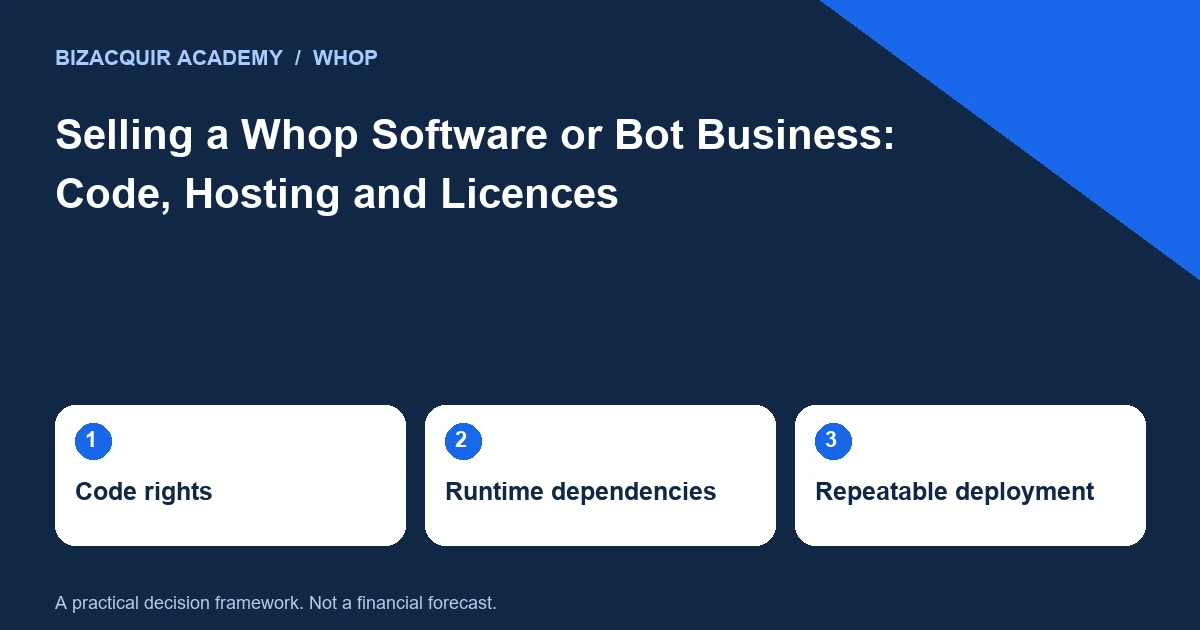
A functioning bot can still be difficult to sell if only its creator knows how to deploy it. Before negotiating, make the software, access model and operational dependencies understandable to a technically capable buyer.
Define the product boundary
List what customers buy: a hosted application, downloadable software, licence key, bot service or access to a connected experience. Whop documents both web-app access checks and licence-key approaches for software. Describe the method your business actually uses rather than implying that a billing connection transfers the product itself. State whether the sale includes source code, build scripts, documentation, domain, design assets and support materials. Explain exclusions, especially shared code used in another business or personal developer accounts.
Build an ownership and dependency inventory
| Component | Questions to answer |
|---|---|
| Source repository | Who owns it, and do contributors have appropriate agreements? |
| Libraries and datasets | What licences apply, and can the buyer continue using them? |
| Hosting and databases | Which services run production, and what are their recurring costs? |
| External APIs | Are quotas, approval or separate contracts required? |
| Distribution | Which app, marketplace or download accounts are involved? |
Keep secrets out of this inventory. List the purpose and transfer method of credentials, not their values. Review old repository history for exposed keys before sharing access; deletion from the current file does not necessarily remove a secret from history.
Demonstrate reproducibility
Use a clean environment to follow the documented build and deployment steps. Record versions, prerequisites, configuration names and verification checks. A successful run on the founder’s laptop is weaker evidence than instructions another authorized person can follow. Hypothetical example: a bot needs a paid data feed and a manually renewed certificate. Its repository is transferable, but those two dependencies are absent from the asking-price discussion. The buyer needs the feed’s consent requirements and renewal workload before assessing the operation. Neither should be disguised as a negligible technical detail.
Show the economics of continued service
Separate collected revenue from hosting, API usage, support and development costs for matching periods. If costs rise with usage, explain the drivers and current limits. A profitable low-usage month may not represent the cost of serving a larger customer base. List known defects and maintenance work. Distinguish an estimate to fix them from a completed repair. Do not promise compatibility with every future platform update or imply that an unsupported automation is authorized by the platform it interacts with.
Agree a verifiable handover
Include repository access, supported ownership changes, a deployment walkthrough, backups, monitoring, documentation and secure rotation of access. GitHub’s repository-transfer guidance describes conditions and consequences worth checking before a transfer; other hosting and developer services have their own rules. On BizAcquir, this is a full business sale with genuine past revenue, not a standalone code licence. Present the working product and historical performance honestly. The buyer should know what can be operated on day one, what must be migrated and what remains dependent on outside approval.
Check the relevant provider guidance
These official references support the platform-specific steps. Your own contracts, account configuration and agreed sale terms still need to be checked.
Explain the operating cost at a realistic workload
For hosted software, compare an ordinary month with a heavier-usage scenario. Identify which costs grow with customers, requests or data rather than assuming every new subscriber is nearly free. Keep model or data-provider credits separate from the ongoing cost.
For AI-dependent products, use the AI software diligence worksheet. The same cost discipline applies to a Whop-distributed bot: the sales platform does not determine the code rights or external service transfer rules.
Your next practical step
Use the WHOP selling checklist to turn the gaps into a preparation plan. You can start a private listing draft or explore a free valuation; signup or login is required to view valuation results.
Continue with Selling a SaaS You No Longer Maintain: What Buyers Need and What to Include in a Whop Business Sale.